It happens every August. I get careless. During a heat wave, I can't stand to wear long pants or long-sleeved shirts or protective clothing of any type. Or sometimes, I am in a hurry, and I take my sneakers off with my hands instead of using the edge of the porch to yank them off.
And then I wake up one morning covered with poison ivy rash.
I've had the rash on every part of my body. One drop of that evil fluid, transferred from my sneakers to my hands, can slide onto any available patch of skin, causing a bubbling, oozing rash. When the rash covers a sensitive part of my body like my breasts, the itching is painful.
One of the most annoying place to get the rash is between my fingers. Today I can barely type because my fingers are so swollen, and fluid from the sores keeps dripping onto the keyboard. During a hike with my family yesterday, the bubbles between my fingers swelled up until I had a blister the size of a kidney bean.
Spouse, who doesn't get poison ivy, looked at the rash with a combination of sympathy and horror. Yet my children, who have inherited my genes and get poison ivy just as badly, were not even one bit sympathetic. Quite the opposite. They treated me like I had leprosy.
My youngest son refused to hold my hand, declaring, "That's gross."
My daughter said helpfully, "I've even seen all those scary films about STI's and that's worse than anything in those health class movies."
"You've ruined my lunch," said Shaggy Hair Boy, "I can't even eat anything after seeing that hand."
"Please put your hand away so we don't have to look at it," said my oldest son.
My husband tried to interject some kind of sympathetic comment but my daughter cut him off. "How can you even sleep in the same bed with that woman? That's just sickening."
That evening, as our extras began arrive for the nightly game of Ultimate Frisbee, I heard one of my kids say, "Hey, want to see something really disgusting?"
And then, "MOM! Com'ere for a minute."
At least they weren't selling tickets.

August 14, 2006


August 12, 2006
Seduction

When I told PlantsWoman that I'd be driving down the west coast with my family, she told me I would have the opportunity to see a rare plant that doesn't grow here in the northeast. See, this is what happens when your friends are scientists. Tell them you are going on vacation, and they don't recommend restaurants or amusement parks or beaches. No, they tell you what unusual plant you can see. I love that.
The darlingtonia californica is a carnivorous plant.
I immediately imagined something like the plant from the The Little Shop of Horrors but she explained that the plant ate insects rather than large mammals. I was a little disappointed, of course, because I think my teenagers would have been more excited by a man-eating plant, but I told her I would look for the road sign as we came down the coast.
Usually I find it hard to pronounce, no less remember, the Latin names that my scientist friends and students toss off so casually, but this one was easy. My Darling Tonia could even be some kind of movie title, I thought. Or certainly a tragically romantic song. "Oh, my darling, oh my darling, oh my darling tonia." And when I checked the internet, I discovered that drowning tragedies happen inside these plants all the time. Perhaps Clementine was an insect.
Sure enough, as we came down the coast, I saw a brown sign that said, "Darlingtonia Wayside." When we pulled into the parking lot, my teenagers were muttering about the fact that we'd already stopped at every scenic lookout or historical marker in the entire state. They were hungry, tired, and ready for lunch. I assured them that they could just stay in the comfort of the car (the rental vehicle, unlike my car at home, had air conditioning), while I popped out to take a look at this unusual plant.
I felt my body relax as I left behind the hot parking lot and cranky children. The trail was deeply shaded by conifers, their aroma released by the summer sun, and lovely green ferns grew in clumps along the edges. I was wondering if I would recognize the plant from my quick glance at an internet photo, which is not the most precise method of plant identification. I kept thinking I should have at least looked up the size of the plant since PlantsWoman, a bryologist, has been known to give enthusiastic descriptions of things that cannot be seen without a magnifying lens. Then I came around a bend in the trail and saw what was, unmistakably a clump of darlingtonia.
One of its common names is the cobra lily, and I could see why. The bed of plants rose like a group of translucent green cobras, reminding me of an animated version of Rudyard Kipling's The Jungle Book.
Insects are lured into the plant by nectar and by plant windows that give them a false sense of security. The windows are translucent, like stained glass windows I guess, and for the insects, I suppose it's like getting lost in the kind of maze of glass that they used to have at the boardwalk, with so many false exits that it's impossible to get out. The upper surface of the tube is glassy and smooth, and insects slide gradually down the slippery slope into the lower tube, where downward pointing hairs trap them. Their bodies disappear into the liquid at the base of the leaf, dissolving into nutrients that can be absorbed by the thin lower walls of the plant.
I could see the temptation. The plant was such a lovely translucent green, glowing in the sunlight that filtered down through the forest canopy. If I could shrink myself small, I would be tempted to explore, to climb inside the hood of the plant to bathe myself in soft green light. The color of the plant windows was more delicate and subtle than stained glass cathedral windows, which seem almost garish in comparison. I could see myself getting lured in by those beautiful windows, scrambling around on the smooth surface, barefoot to get a better grip, but then slipping inevitably down. Lost and gone forever. Oh, my darling tonia.
I stared at the plant, trying to picture the scene: would I struggle and beat my wings against the hairs that trapped me? Or give in to the inevitable and slide gracefully as if I were on a toboggan run, entering the pool with a splash?
Then I looked up and realized that my family, lured by the darlingtonia, had left the car, followed the trail, and were clustered on the boardwalk next to me. They, too, seemed mesmerized by the plant. With-a-Why leaned over the railing to get a closer look, his face just centimeters away those translucent green hoods.
A very seductive plant.
August 11, 2006
Cousins
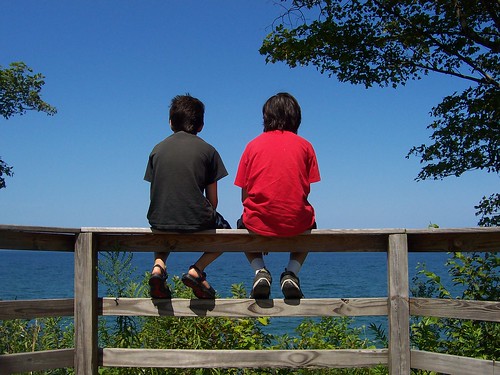
With-a-Why and Suburban Nephew were born only a few weeks apart. It's the kind of thing that happens in my family: whenever I get pregnant, one of my sisters will conveniently get pregnant so that my kid will have a playmate close in age. When Red-haired Sister is in town, With-a-Why and Suburban Nephew play together for hours every day. Two small boys can find all kinds of things to do on a lazy summer day.
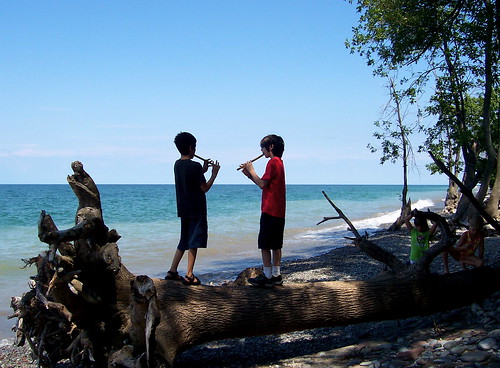
We spent this afternoon at the Very Big Lake, visiting a little nature center and then hiking down to a beach full of smooth rounded rocks. My parents brought a picnic lunch for all of us. (Yes, that's right. I am 45 and my Mom still makes my lunch. Well, only on outings.) Dandelion Niece and Neighbor Girl stripped off their clothes to play in the surf, since the crashing waves were just the right size for their small bodies.
But With-a-Why and Suburban Nephew had purchased bamboo flutes at the nature center. With-a-Why, who plays the piano and jams with his brothers, figured out quickly how to play notes and then a tune, and Suburban Nephew caught on quickly. Delighted with themselves, they played the high-pitched instruments as loudly as they could, all the way down the trail through the woods and down to the rocky beach, where thankfully the crash of waves helped muffled their song.
August 10, 2006
The red room
We found it quite by accident. It was April of 2000 and for reasons I cannot disclose (although I suppose my Four Seas friends will guess), I was wandering in the dark and cold and bitter winds of Twin City.
Mentor Poet and Brooklyn Friend were with me, and we were lost. Completely lost. We'd been to a couple of bars already, and the last one had been a strange warehouse place filled with teenagers wearing black, and music so loud that my head was throbbing. I had a bad cold, the start of a migraine, and no coat. We started back in the general direction of our hotel, or where we thought our hotel might be, but nothing looked familiar, and the cold wind just kept slapping against my neck. Brooklyn Friend said that we would go into the next bar we saw, no matter what it looked like, just so we could get warm and use the bathrooms.
We turned the corner, saw a door, and walked in.
It was like stepping into a television set. The people in this place had silky hair and fancy clothes, and the kind of sheen that goes with privilege. White cloths covered the small tables, and the vases held red roses, real roses, and all of this was set against a background of varnished wood. Feeling completely out of place, with our shivering red fingers and wind-tangled hair, we moved quickly through the room, desperate to get to the warm bathrooms in the back.
As soon as we entered the back room, I realized that those customers out in front, all seated near the main window, were just window dressing, perhaps hired to make the place look classy, and that the heart of the place was in the back.
A polished wood bar ran the length of the back room, with seats all along the edge and several cosy niches. Three friends were clustered over by a fireplace, talking and laughing. Waiters, tired of serving the rich people out front, were gathered by the kitchen door, joking around. One couple had found a romantic spot, over in the corner, half-hidden from view. Above us were high ceilings and a loft that held a pool table. The loft looked like a section taken off an old sailing vessel. Even the bathrooms were cool, filled with old photographs.
It didn't take me long to find the best spot. Halfway between the wooden bar and the swinging kitchen door, right along the path the waiters had to take, was an open doorway to a small separate room. The room, painted deep red, held a couch and two chairs, and an old lamp with a yellowed shade. Some young couple were in there, taking advantage of the dim light. Right then and there I decided that our goal should be to get to this bar early on Saturday and claim the red room for the evening.
Mentor Poet and Brooklyn Friend agreed. So we returned early the next evening, with Wisconsin Woman, and went straight to the red room.
We sat all night in that glowing red room, talking, drinking, eating potatoes and cheese and weird appetizers that Brooklyn Friend kept ordering. We confided in each other. We talked about relationships, about work, about sex, about marriage, about family and childhood. We moved from topic to topic, a serious although not linear conversation, and yet it did not seem serious. Mentor Poet kept joking around, and our laughter filled the room again and again. I was sprawled on the couch, and sometimes I just had to put my head down into the pillows because I was laughing so hard.
Mentor Poet has a contagious laugh, and the waiters could not resist stopping at the doorway to talk to us. One young waiter kept telling us that he wanted to be a stand-up comic, but when asked to tell a joke, he completely blanked out. Was it cruel for us to laugh? He kept returning at intervals for the rest of the night with lame jokes.
It was just the right combination – the glow from the lamp and the deep red walls holding us close – the intimacy of a small space, yet the view of the bar and the constant hustle of waiters going by. We could hear the clink of glasses from the bar, the murmur of conversations, and the faint knocking of pool balls. The route to the bathrooms went just past the door so the room was perfect for people watching. A woman in a black dress, very elegant, appeared out of nowhere and burst out, "Oh, you have the red room. You're so lucky. I love the red room." Her envy put the finishing touch on the evening.
Mentor Poet and Brooklyn Friend were with me, and we were lost. Completely lost. We'd been to a couple of bars already, and the last one had been a strange warehouse place filled with teenagers wearing black, and music so loud that my head was throbbing. I had a bad cold, the start of a migraine, and no coat. We started back in the general direction of our hotel, or where we thought our hotel might be, but nothing looked familiar, and the cold wind just kept slapping against my neck. Brooklyn Friend said that we would go into the next bar we saw, no matter what it looked like, just so we could get warm and use the bathrooms.
We turned the corner, saw a door, and walked in.
It was like stepping into a television set. The people in this place had silky hair and fancy clothes, and the kind of sheen that goes with privilege. White cloths covered the small tables, and the vases held red roses, real roses, and all of this was set against a background of varnished wood. Feeling completely out of place, with our shivering red fingers and wind-tangled hair, we moved quickly through the room, desperate to get to the warm bathrooms in the back.
As soon as we entered the back room, I realized that those customers out in front, all seated near the main window, were just window dressing, perhaps hired to make the place look classy, and that the heart of the place was in the back.
A polished wood bar ran the length of the back room, with seats all along the edge and several cosy niches. Three friends were clustered over by a fireplace, talking and laughing. Waiters, tired of serving the rich people out front, were gathered by the kitchen door, joking around. One couple had found a romantic spot, over in the corner, half-hidden from view. Above us were high ceilings and a loft that held a pool table. The loft looked like a section taken off an old sailing vessel. Even the bathrooms were cool, filled with old photographs.
It didn't take me long to find the best spot. Halfway between the wooden bar and the swinging kitchen door, right along the path the waiters had to take, was an open doorway to a small separate room. The room, painted deep red, held a couch and two chairs, and an old lamp with a yellowed shade. Some young couple were in there, taking advantage of the dim light. Right then and there I decided that our goal should be to get to this bar early on Saturday and claim the red room for the evening.
Mentor Poet and Brooklyn Friend agreed. So we returned early the next evening, with Wisconsin Woman, and went straight to the red room.
We sat all night in that glowing red room, talking, drinking, eating potatoes and cheese and weird appetizers that Brooklyn Friend kept ordering. We confided in each other. We talked about relationships, about work, about sex, about marriage, about family and childhood. We moved from topic to topic, a serious although not linear conversation, and yet it did not seem serious. Mentor Poet kept joking around, and our laughter filled the room again and again. I was sprawled on the couch, and sometimes I just had to put my head down into the pillows because I was laughing so hard.
Mentor Poet has a contagious laugh, and the waiters could not resist stopping at the doorway to talk to us. One young waiter kept telling us that he wanted to be a stand-up comic, but when asked to tell a joke, he completely blanked out. Was it cruel for us to laugh? He kept returning at intervals for the rest of the night with lame jokes.
It was just the right combination – the glow from the lamp and the deep red walls holding us close – the intimacy of a small space, yet the view of the bar and the constant hustle of waiters going by. We could hear the clink of glasses from the bar, the murmur of conversations, and the faint knocking of pool balls. The route to the bathrooms went just past the door so the room was perfect for people watching. A woman in a black dress, very elegant, appeared out of nowhere and burst out, "Oh, you have the red room. You're so lucky. I love the red room." Her envy put the finishing touch on the evening.
August 08, 2006
A friend tells a friend
It was a gathering of poets and artists, survivors and friends of survivors, grandmothers and urban professionals and high school students. We met last night at a coffeehouse in Snowstorm City for a poetry reading that would raise money for the Women's Shelter.
Poet Woman and I went out to dinner first, a slow meal at a downtown restaurant that serves the most wonderful bread and hot tomato dipping sauce. We talked and ate and talked, and the waiter kept bringing us more bread and dipping sauce. Afterwards, we walked through the city, taking our shoes off to splash barefoot through the fountain that was shooting jets of white water against the sunset.
Then for the next three hours, in a cosy coffeehouse filled with women and artwork, we listened as one by one, people approached the microphone and told their stories We were celebrating the survivors of domestic abuse, their strength and resilience, and the room was filled with survivors. But when Poet Woman got up to read, she asked for a moment of silence, for some of the women she remembered from the shelter, women who were warm and loving and wonderful, women who did not survive. I closed my eyes during the moment of silence, hiding behind my hair, because I could not bear to look at the faces around me.
The room was quiet as Poet Woman read a poem about the time many years ago when she was getting beaten by her husband, and someone called the cops. The cops arrived and asked one question: "Is this your husband?" And when she said yes, they left, and the beating continued. It was 1966, and that was the law then.
The evening went late, and it was close to midnight before everyone had spoken. I kept thinking how important it was for our community to say those words aloud, to name abuse and acknowledge pain.
The rule of silence in a dysfunctional family is a powerful force that feeds the cycle of abuse. "Don't air the dirty laundry." The clothesline project draws on that symbolism: women write their pain onto shirts which are then hung on a clothesline. Speaking up and speaking out is an act of incredible courage that helps break the pattern of abuse.
That step of finding words for the pain, for acknowledging the abuse, seems to be an important moment in every survivor's story. It's the way cycles get broken, patterns get changed. A friend tells a friend. Secrets lose their power when they are no longer secrets. Words rip apart the silence.
A friend tells a friend. I don't understand completely the healing process but I have seen it work. I could feel it last night as women and men spoke into the microphone, and everyone in the room listened, trying with their bodies to absorb the pain, to pull it into their bodies so that that the pain could become diffuse and shared. I tried to think of all the experiences I've stored in my body -- lazy summer days at camp, a drive around a deep blue lake, strolls along a coastal beach, a walk through ancient trees -- and use those sunny moments as a way to buffer the painful words I was listening to with my whole self.
Poet Woman and I went out to dinner first, a slow meal at a downtown restaurant that serves the most wonderful bread and hot tomato dipping sauce. We talked and ate and talked, and the waiter kept bringing us more bread and dipping sauce. Afterwards, we walked through the city, taking our shoes off to splash barefoot through the fountain that was shooting jets of white water against the sunset.
Then for the next three hours, in a cosy coffeehouse filled with women and artwork, we listened as one by one, people approached the microphone and told their stories We were celebrating the survivors of domestic abuse, their strength and resilience, and the room was filled with survivors. But when Poet Woman got up to read, she asked for a moment of silence, for some of the women she remembered from the shelter, women who were warm and loving and wonderful, women who did not survive. I closed my eyes during the moment of silence, hiding behind my hair, because I could not bear to look at the faces around me.
The room was quiet as Poet Woman read a poem about the time many years ago when she was getting beaten by her husband, and someone called the cops. The cops arrived and asked one question: "Is this your husband?" And when she said yes, they left, and the beating continued. It was 1966, and that was the law then.
The evening went late, and it was close to midnight before everyone had spoken. I kept thinking how important it was for our community to say those words aloud, to name abuse and acknowledge pain.
The rule of silence in a dysfunctional family is a powerful force that feeds the cycle of abuse. "Don't air the dirty laundry." The clothesline project draws on that symbolism: women write their pain onto shirts which are then hung on a clothesline. Speaking up and speaking out is an act of incredible courage that helps break the pattern of abuse.
That step of finding words for the pain, for acknowledging the abuse, seems to be an important moment in every survivor's story. It's the way cycles get broken, patterns get changed. A friend tells a friend. Secrets lose their power when they are no longer secrets. Words rip apart the silence.
A friend tells a friend. I don't understand completely the healing process but I have seen it work. I could feel it last night as women and men spoke into the microphone, and everyone in the room listened, trying with their bodies to absorb the pain, to pull it into their bodies so that that the pain could become diffuse and shared. I tried to think of all the experiences I've stored in my body -- lazy summer days at camp, a drive around a deep blue lake, strolls along a coastal beach, a walk through ancient trees -- and use those sunny moments as a way to buffer the painful words I was listening to with my whole self.
August 07, 2006
It's a bird! It's a plane!
I wrote my syllabus this morning, complete with assignment schedule. THREE WEEKS BEFORE THE FIRST DAY OF CLASS. A major accomplishment.
I usually wait until the very last minute to do this kind of thing. In fact, I can think of only two other times I've done my fall prep ahead of time. In the year 1994, I was expecting a baby, my fourth child, in the middle of the semester, and I knew that I wouldn't have a whole lot of energy after the heat of August sapped the strength out of my hugely pregnant body, so I did all my class prep in May, while I was in the happy high-energy phase of pregnancy and the weather was still cool. And last year, I was planning to spend two weeks on a whitewater raft trip and needed to get my work done ahead of time.
This year, I have neither a new baby or an exciting raft trip in my future, but we weren't able to go to go to camp this weekend – we stayed close to home to field phone calls from my mother-in-law and help her make the transition to her new living arrangement – so I figured I might as well get some work done so that I can relax and enjoy the rest of my summer.
One disadvantage of doing my fall prep way ahead of time is that I tend to be a bit unrealistic about fall semester. I'll look at the first week of October and say to myself, "Let's see. I'll have the students hand in this paper on Monday, I'll grade them on Tuesday, and I should be able to hand them all back on Wednesday, and I'll have Thursday to write." Because yeah, it is totally realistic to think that I will be able to grade 65 essays, writing careful inspiring comments on them, in a matter of hours on a single Tuesday at home.
On lazy summer days, though, I have this vision of myself turning into superwoman once the cooler fall weather gets here. I convince myself that a simple drop in temperature will turn me from sloth to overachiever. Sure, I will be turning papers back the same week they are handed in.
And I haven't met my students yet, so of course I imagine them participating in amazing discussions and writing fantastic papers. It's fun to write a syllabus for imaginary students and an imaginary superwoman teacher.
But once I finished the syllabus, I stopped to do the numbers. I will be assigning five formal papers, and 21 short response papers. Yes, I am sure 21 short papers seems like a lot, but I assign a short paper to go with every single reading. My official reason is that all that writing is good for the students. Mostly though, I don't have the patience to hold class with students who haven't done the reading. I hate when they do stupid things like try to discuss the title all class because yeah, they think somehow the teacher won't know that they haven't gotten beyond the title. It drives me nuts when I am prepared for class and they aren't.
Forcing students to write does force them to do the reading and to think about the reading. It also means that this fall I will read and respond to 2665 pages of student writing. I like to calculate these numbers so that I can repeatedly toss them into conversations with the academic dean. He's a scientist, and numbers are what get through to him. Those kind of numbers help stop anyone who has ideas about giving me another section to teach.
But they also serve to bring me back to reality.
And now I am going back into summertime sloth mode before I think about it too much.
I usually wait until the very last minute to do this kind of thing. In fact, I can think of only two other times I've done my fall prep ahead of time. In the year 1994, I was expecting a baby, my fourth child, in the middle of the semester, and I knew that I wouldn't have a whole lot of energy after the heat of August sapped the strength out of my hugely pregnant body, so I did all my class prep in May, while I was in the happy high-energy phase of pregnancy and the weather was still cool. And last year, I was planning to spend two weeks on a whitewater raft trip and needed to get my work done ahead of time.
This year, I have neither a new baby or an exciting raft trip in my future, but we weren't able to go to go to camp this weekend – we stayed close to home to field phone calls from my mother-in-law and help her make the transition to her new living arrangement – so I figured I might as well get some work done so that I can relax and enjoy the rest of my summer.
One disadvantage of doing my fall prep way ahead of time is that I tend to be a bit unrealistic about fall semester. I'll look at the first week of October and say to myself, "Let's see. I'll have the students hand in this paper on Monday, I'll grade them on Tuesday, and I should be able to hand them all back on Wednesday, and I'll have Thursday to write." Because yeah, it is totally realistic to think that I will be able to grade 65 essays, writing careful inspiring comments on them, in a matter of hours on a single Tuesday at home.
On lazy summer days, though, I have this vision of myself turning into superwoman once the cooler fall weather gets here. I convince myself that a simple drop in temperature will turn me from sloth to overachiever. Sure, I will be turning papers back the same week they are handed in.
And I haven't met my students yet, so of course I imagine them participating in amazing discussions and writing fantastic papers. It's fun to write a syllabus for imaginary students and an imaginary superwoman teacher.
But once I finished the syllabus, I stopped to do the numbers. I will be assigning five formal papers, and 21 short response papers. Yes, I am sure 21 short papers seems like a lot, but I assign a short paper to go with every single reading. My official reason is that all that writing is good for the students. Mostly though, I don't have the patience to hold class with students who haven't done the reading. I hate when they do stupid things like try to discuss the title all class because yeah, they think somehow the teacher won't know that they haven't gotten beyond the title. It drives me nuts when I am prepared for class and they aren't.
Forcing students to write does force them to do the reading and to think about the reading. It also means that this fall I will read and respond to 2665 pages of student writing. I like to calculate these numbers so that I can repeatedly toss them into conversations with the academic dean. He's a scientist, and numbers are what get through to him. Those kind of numbers help stop anyone who has ideas about giving me another section to teach.
But they also serve to bring me back to reality.
And now I am going back into summertime sloth mode before I think about it too much.
August 06, 2006
Signs
Laura over at 11D asked her readers to tell stories about their involvement with the local political process. I could tell a number of stories about rallies I've gone to, or issues I was involved in during my years as editor of an alternative publication, but instead I'd like to tell the story that involves something that seems pretty mundane: road signs.
When I was in my twenties, with three small kids (With-a-Why came later), I lived in a quiet neighborhood of small houses lined up close to the road, a neighborhood not far from where I had grown up. Many of my elderly neighbors had lived in the neighborhood for more than forty years, and on summer evenings, they would sit outside on their paved driveways in metal lawn chairs. Sprinkled amidst the somber old houses with their neat lawns and flower-filled window boxes were also houses in which the short front driveways were filled with bright-coloured toys and red tricycles and playpens. Every time a long-time resident of the neighborhood died, the house would get sold by the estate and a young family would move in.
The road we lived on was the back route to a big manufacturing plant, one of the big employers in the area, and twice each day, our quiet street would fill with cars racing by at high speeds, as shift workers took the short cut to get to work on time, many of them traveling more than 30 mph over the posted speed limit. The traffic made the street a dangerous place for both children and old people. The woman next door to me, who was in her eighties and who still walked to the laundromat and the store, had several bad scares, nearly getting run down by fast-moving cars. I kept my own children in our fenced-in back yard, but had to let them walk in our small front yard if I wanted to go someplace in the car. I couldn’t carry three kids at a time, and I always felt fearful until all three kids were safely strapped into the car. If the kids wanted to ride tricycles and play on the paved driveway, I would sit at the end of the driveway, worried the whole time that a kid might dart into the road. But mostly, it wasn’t my own children who were in danger. A couple of houses down lived three boys in a difficult household, whose parents did not supervise them at all. I kept those three boys in my backyard whenever I could, but I knew that they had no one to protect them when we were off on one of our camping trips, and that they often played in the road.
I knew that other residential neighborhoods had stop signs on every corner in order to slow traffic down and make the place safe. It seemed to me that stop signs would solve the problem.
So I drew up a petition to the town, asking for stop signs, and went from door-to-door with the petition. I picked a sunny weekend and left the kids home with my spouse, while I walked from house to house.
Many of the nearest neighbors knew me, but as I moved farther down the street, I found I needed to introduce myself. Since I'd lived in the area my whole life, that wasn't hard. I’d talk about which schools I'd attended – some of my neighbors had kids who had gone to school with me – and I'd mention my father, because most people remembered the office he’d had on the main street for years. Almost everyone was friendly and nice: many asked me to sit down and chat. They offered me cookies and juice, or coffee.
Even as I chatted with the neighbors, I realized I was sort of playing a role. These were white conservative working-class people. In every case, I made a point of mentioning what I had in common with them. Never once did I mention my affiliation with the university, which would have made them mistrust me, and most certainly, nothing about my liberal politics. If my skin had been a different color, or if I had a lesbian partner, or if I was a young professor from out of town who had just moved into the neighborhood, would I have gotten such a warm reception? I suspect not.
Most of the neighbors signed the petition, but mostly just to humor me. I kept hearing things like, "Honey, that traffic's been a problem ever since that plant opened. It's been like that for years. It's dangerous but nothing we can do about it." Almost every one of my neighbors warned me that I was wasting my time. Everyone agreed that the speeding cars were a problem, but they all seemed resigned to just accept the situation.
One woman, LikesQuiet, whom I knew because I'd gone to school with her kids, said she didn't want the stop signs because it would make her life more difficult. She'd have to drive slower going through the neighborhood. She'd raised her own kids with that traffic, and none of them had been hit by a car, and she figured that if mothers didn't keep an eye on her kids, well, that was their problem. I knew I wasn't going to get her signature as soon as she started her spiel, so I shrugged, admired her garden, talked about how nice her dog was, and then moved onto the next house.
Pretty much everyone else signed the petition. I sent it to the town, and they put the stop signs on the agenda for the next town board meeting.
Five other couples went to the town meeting, all of them older residents. When it was time for discussion, I noticed another strange dynamic, something that will likely indicate what a conservative community I come from. When it was time to talk, the husband would stand up and say, "We are Mr. and Mrs. Neighbor. We think ...."
It happened five times. Not one of the women said a word. In each case, the husband would stand up and say something in first person plural, and that would be it. It drives me crazy when married people talk in the first person plural, as if they aren't separate people, but on top of that, I remember thinking it was a poor strategy. Even if both spouses agreed on the issue, having only one person talk effectively gave them one voice instead of two.
As soon as I saw what was happening, I moved a chair away from my husband. I knew he was planning to speak up, and I didn't want anyone to assume he was speaking for me. He and I did agree on the issue, but I wanted us to count as two voices, and not one. I knew I could trust him not to speak in first person plural. And I was deliberately waiting until everyone had spoken, because I wanted to be last.
Four men (including my husband) said they were in favor of the stop signs. And two men, including LikesQuiet's husband, came up with reasons why the stop signs shouldn’t be there. One man said he thought the stop signs would make people drive faster, because they would get angry that the signs were making them even later for work.
When all the men in the audience had spoken and it became clear to me that none of the women were going to speak, I stood up and said that I had circulated the petition. I explained my reasons, saying that the speeding cars were a danger especially to the children and older people in the neighborhood, and that as a community we needed to protect both the young and the old. I said: "We can't risk an accident happening."
The board discussed the issue briefly, but I knew my last sentence would seal the deal. As long as it doesn't conflict with a significant economic issue, local governments will usually act to avoid risk. Installing four stop signs would be pretty cheap. They could not afford the risk of an accident happening after residents had specifically asked for a measure that would make the neighborhood safer.
They voted unanimously in favor of the motion. And several days later, the neighborhood kids and I watched while workers from the town unloaded stop signs from their truck and pounded them in.
When I was in my twenties, with three small kids (With-a-Why came later), I lived in a quiet neighborhood of small houses lined up close to the road, a neighborhood not far from where I had grown up. Many of my elderly neighbors had lived in the neighborhood for more than forty years, and on summer evenings, they would sit outside on their paved driveways in metal lawn chairs. Sprinkled amidst the somber old houses with their neat lawns and flower-filled window boxes were also houses in which the short front driveways were filled with bright-coloured toys and red tricycles and playpens. Every time a long-time resident of the neighborhood died, the house would get sold by the estate and a young family would move in.
The road we lived on was the back route to a big manufacturing plant, one of the big employers in the area, and twice each day, our quiet street would fill with cars racing by at high speeds, as shift workers took the short cut to get to work on time, many of them traveling more than 30 mph over the posted speed limit. The traffic made the street a dangerous place for both children and old people. The woman next door to me, who was in her eighties and who still walked to the laundromat and the store, had several bad scares, nearly getting run down by fast-moving cars. I kept my own children in our fenced-in back yard, but had to let them walk in our small front yard if I wanted to go someplace in the car. I couldn’t carry three kids at a time, and I always felt fearful until all three kids were safely strapped into the car. If the kids wanted to ride tricycles and play on the paved driveway, I would sit at the end of the driveway, worried the whole time that a kid might dart into the road. But mostly, it wasn’t my own children who were in danger. A couple of houses down lived three boys in a difficult household, whose parents did not supervise them at all. I kept those three boys in my backyard whenever I could, but I knew that they had no one to protect them when we were off on one of our camping trips, and that they often played in the road.
I knew that other residential neighborhoods had stop signs on every corner in order to slow traffic down and make the place safe. It seemed to me that stop signs would solve the problem.
So I drew up a petition to the town, asking for stop signs, and went from door-to-door with the petition. I picked a sunny weekend and left the kids home with my spouse, while I walked from house to house.
Many of the nearest neighbors knew me, but as I moved farther down the street, I found I needed to introduce myself. Since I'd lived in the area my whole life, that wasn't hard. I’d talk about which schools I'd attended – some of my neighbors had kids who had gone to school with me – and I'd mention my father, because most people remembered the office he’d had on the main street for years. Almost everyone was friendly and nice: many asked me to sit down and chat. They offered me cookies and juice, or coffee.
Even as I chatted with the neighbors, I realized I was sort of playing a role. These were white conservative working-class people. In every case, I made a point of mentioning what I had in common with them. Never once did I mention my affiliation with the university, which would have made them mistrust me, and most certainly, nothing about my liberal politics. If my skin had been a different color, or if I had a lesbian partner, or if I was a young professor from out of town who had just moved into the neighborhood, would I have gotten such a warm reception? I suspect not.
Most of the neighbors signed the petition, but mostly just to humor me. I kept hearing things like, "Honey, that traffic's been a problem ever since that plant opened. It's been like that for years. It's dangerous but nothing we can do about it." Almost every one of my neighbors warned me that I was wasting my time. Everyone agreed that the speeding cars were a problem, but they all seemed resigned to just accept the situation.
One woman, LikesQuiet, whom I knew because I'd gone to school with her kids, said she didn't want the stop signs because it would make her life more difficult. She'd have to drive slower going through the neighborhood. She'd raised her own kids with that traffic, and none of them had been hit by a car, and she figured that if mothers didn't keep an eye on her kids, well, that was their problem. I knew I wasn't going to get her signature as soon as she started her spiel, so I shrugged, admired her garden, talked about how nice her dog was, and then moved onto the next house.
Pretty much everyone else signed the petition. I sent it to the town, and they put the stop signs on the agenda for the next town board meeting.
Five other couples went to the town meeting, all of them older residents. When it was time for discussion, I noticed another strange dynamic, something that will likely indicate what a conservative community I come from. When it was time to talk, the husband would stand up and say, "We are Mr. and Mrs. Neighbor. We think ...."
It happened five times. Not one of the women said a word. In each case, the husband would stand up and say something in first person plural, and that would be it. It drives me crazy when married people talk in the first person plural, as if they aren't separate people, but on top of that, I remember thinking it was a poor strategy. Even if both spouses agreed on the issue, having only one person talk effectively gave them one voice instead of two.
As soon as I saw what was happening, I moved a chair away from my husband. I knew he was planning to speak up, and I didn't want anyone to assume he was speaking for me. He and I did agree on the issue, but I wanted us to count as two voices, and not one. I knew I could trust him not to speak in first person plural. And I was deliberately waiting until everyone had spoken, because I wanted to be last.
Four men (including my husband) said they were in favor of the stop signs. And two men, including LikesQuiet's husband, came up with reasons why the stop signs shouldn’t be there. One man said he thought the stop signs would make people drive faster, because they would get angry that the signs were making them even later for work.
When all the men in the audience had spoken and it became clear to me that none of the women were going to speak, I stood up and said that I had circulated the petition. I explained my reasons, saying that the speeding cars were a danger especially to the children and older people in the neighborhood, and that as a community we needed to protect both the young and the old. I said: "We can't risk an accident happening."
The board discussed the issue briefly, but I knew my last sentence would seal the deal. As long as it doesn't conflict with a significant economic issue, local governments will usually act to avoid risk. Installing four stop signs would be pretty cheap. They could not afford the risk of an accident happening after residents had specifically asked for a measure that would make the neighborhood safer.
They voted unanimously in favor of the motion. And several days later, the neighborhood kids and I watched while workers from the town unloaded stop signs from their truck and pounded them in.
August 04, 2006
Difficult
The assisted living home is lovely, with big windows that let in sunshine, a courtyard with flower gardens, a dining area that looks more like a nice restaurant, a cheerful staff, beautiful efficiency apartments, and everything an elderly person could ask for. And yet, it was a difficult move.
My mother-in-law had toured the facility and agreed that she wanted to move there. She needs help with everything from taking a shower to sorting out her medications. Her eyesight is failing. She liked the place and all the services it has to offer. The building is only about a mile from where she lives now, within fifteen miles of both of her sons. And yet, it was a difficult move.
Today we moved my mother-in-law out of a home she's lived in for 47 years. It's the home she moved into soon after she married, the home where she raised her children, the home of 47 Christmas trees, 47 Easter celebrations, and 47 summers. It's a home she can no longer take care of, with a driveway that becomes dangerous on icy winter days, a garage that holds a car she can no longer drive. It is no longer a house that is safe for someone with failing eyesight and shaky limbs. And yet, it was difficult for her to leave.
Her children and children-in-law and grandchildren all agreed that this was the best move. We all agreed that new place was wonderful. We knew she would cry this morning when we arrived to move her in, but that in the long run she would be pleased with the move. We all knew it was the right thing to do, that she needs the help of a staff who is there 24 hours each day. For the last few years, her three kids have spent endless hours taking care of her house, driving her places, shopping for her, doing errands for her, answering her phone calls in the middle of the night, taking her to countless doctors, and reassuring her when she gets scared by a thunderstorm or anxious over some medication. We all knew the time had come to move her, that the care we could provide on an almost daily basis was no longer enough.
And still, it was a difficult move.
My mother-in-law had toured the facility and agreed that she wanted to move there. She needs help with everything from taking a shower to sorting out her medications. Her eyesight is failing. She liked the place and all the services it has to offer. The building is only about a mile from where she lives now, within fifteen miles of both of her sons. And yet, it was a difficult move.
Today we moved my mother-in-law out of a home she's lived in for 47 years. It's the home she moved into soon after she married, the home where she raised her children, the home of 47 Christmas trees, 47 Easter celebrations, and 47 summers. It's a home she can no longer take care of, with a driveway that becomes dangerous on icy winter days, a garage that holds a car she can no longer drive. It is no longer a house that is safe for someone with failing eyesight and shaky limbs. And yet, it was difficult for her to leave.
Her children and children-in-law and grandchildren all agreed that this was the best move. We all agreed that new place was wonderful. We knew she would cry this morning when we arrived to move her in, but that in the long run she would be pleased with the move. We all knew it was the right thing to do, that she needs the help of a staff who is there 24 hours each day. For the last few years, her three kids have spent endless hours taking care of her house, driving her places, shopping for her, doing errands for her, answering her phone calls in the middle of the night, taking her to countless doctors, and reassuring her when she gets scared by a thunderstorm or anxious over some medication. We all knew the time had come to move her, that the care we could provide on an almost daily basis was no longer enough.
And still, it was a difficult move.
August 03, 2006
Summer Storm
After two days of unbearable heat and humidity, two days of lying on the floor, two days of drinking juice and eating nothing, two days of going nowhere because I couldn't bear to get into a car that was so hot it hurt to touch the metal handles, I could feel the headache beginning: my vision getting blurry and throbbing inside my skull and my eyes unable to handle even the gentlest light. But when the air is so thick that walking feels like swimming and the heat so intense that it's hard to breathe, I almost welcome a migraine because I know what it means. A low pressure system moving towards us. A thunderstorm.
A change in weather.
This morning, the wind is blowing through the branches of the trees outside my window, sending a flurry of raindrops to the ground, and cool air is moving through the house. The pressure in my head has subsided. The windowsills are wet, and mosquitoes have wiggled their way through the many holes in our battered screens, and the air in the house tastes sweet again.
A change in weather.
This morning, the wind is blowing through the branches of the trees outside my window, sending a flurry of raindrops to the ground, and cool air is moving through the house. The pressure in my head has subsided. The windowsills are wet, and mosquitoes have wiggled their way through the many holes in our battered screens, and the air in the house tastes sweet again.
August 01, 2006
Heat Wave
Here is the scene at my house: everywhere you see the dead bodies of cats, sprawled out limp on the linoleum. Oh, okay, maybe they aren’t really dead, they are just sleeping, but that's the effect. Seven limp cats, draped on the floor, unable to move in the heat. They aren't even hissing at each other. In this heat, they've called some kind of truce.
Of course, the bigger lumps on the floor, clad mostly in black t-shirts and shorts, are kids. Boy in Black and Shaggy Hair decided yesterday evening that their strategy for handling the heat wave would be to stay up all night celebrating the fact that July was over. (Their evil mother had banned computer games for the month of July.) Their plan was to play computer games all night and then spend the day sleeping on the floor. Every once in a while, Shaggy Hair will sit up and complain, "It’s too hot to sleep," before falling back into a sound sleep.
The voice on the radio tells us that a running race has been cancelled. And we are supposed to check on elderly neighbors. We are a region well-prepared to deal with snowstorms: heat waves, not so much.
Skater Boy is lying on the floor with an ice pack on his head, which makes him look wounded even though he is not. Pirate Boy, unbelievably, is sitting at the computer. I say unbelievably because the kids' computer is in an upstairs bedroom with a southeast exposure and the room feels like the inside of a dishwasher. The even more unbelievable part is that both these kids live in homes that have air conditioning and for some inexplicable reason are at my house instead. Blonde Niece, clad in a bathing suit, with her hair wet and pulled back from her face, is lying on the floor in the hallway, where she claims she is catching a breeze from one of two electric fans that we own.
My Beautiful Smart Wonderful Daughter is talking happily on her cell phone to Film Guy, whose grandmother has a pool and has invited her over. She volunteers at a women's shelter and spent a sweaty morning lugging bags of clothes and boxes of belongings over sizzling city sidewalks to move several women into apartments. So she probably deserves a swim. With-a-Why, on the other hand, has not moved all day: he is lying on the floor, reading a book. I don’t think anyone in the house has eaten anything, although the kitchen counter is crowded with glasses from the many glasses of juice we've had. Oh, Blonde Niece did cut up the watermelon. Can we count that as lunch?
As I lie on the floor, I tell myself to soak in the heat, let it somehow enter my bones, where I will store it for the cold winter ahead. Next January, when I am sitting on a chairlift, after several runs down the ski slope, and I am shivering with cold, the wind sending chills through my wet clothes and my feet so icy that they are painful, I will try to remember this heat.
I tell one of my kids this theory about heat, how we can store it up in our bones the way plants turn summer sunlight into food for the winter. He lifts his head from the floor and mutters, "Humans don’t have chlorophyll."
Of course, the bigger lumps on the floor, clad mostly in black t-shirts and shorts, are kids. Boy in Black and Shaggy Hair decided yesterday evening that their strategy for handling the heat wave would be to stay up all night celebrating the fact that July was over. (Their evil mother had banned computer games for the month of July.) Their plan was to play computer games all night and then spend the day sleeping on the floor. Every once in a while, Shaggy Hair will sit up and complain, "It’s too hot to sleep," before falling back into a sound sleep.
The voice on the radio tells us that a running race has been cancelled. And we are supposed to check on elderly neighbors. We are a region well-prepared to deal with snowstorms: heat waves, not so much.
Skater Boy is lying on the floor with an ice pack on his head, which makes him look wounded even though he is not. Pirate Boy, unbelievably, is sitting at the computer. I say unbelievably because the kids' computer is in an upstairs bedroom with a southeast exposure and the room feels like the inside of a dishwasher. The even more unbelievable part is that both these kids live in homes that have air conditioning and for some inexplicable reason are at my house instead. Blonde Niece, clad in a bathing suit, with her hair wet and pulled back from her face, is lying on the floor in the hallway, where she claims she is catching a breeze from one of two electric fans that we own.
My Beautiful Smart Wonderful Daughter is talking happily on her cell phone to Film Guy, whose grandmother has a pool and has invited her over. She volunteers at a women's shelter and spent a sweaty morning lugging bags of clothes and boxes of belongings over sizzling city sidewalks to move several women into apartments. So she probably deserves a swim. With-a-Why, on the other hand, has not moved all day: he is lying on the floor, reading a book. I don’t think anyone in the house has eaten anything, although the kitchen counter is crowded with glasses from the many glasses of juice we've had. Oh, Blonde Niece did cut up the watermelon. Can we count that as lunch?
As I lie on the floor, I tell myself to soak in the heat, let it somehow enter my bones, where I will store it for the cold winter ahead. Next January, when I am sitting on a chairlift, after several runs down the ski slope, and I am shivering with cold, the wind sending chills through my wet clothes and my feet so icy that they are painful, I will try to remember this heat.
I tell one of my kids this theory about heat, how we can store it up in our bones the way plants turn summer sunlight into food for the winter. He lifts his head from the floor and mutters, "Humans don’t have chlorophyll."
Subscribe to:
Posts (Atom)