February 17, 2008


February 16, 2008
When we give ourselves wings
In my part of the world, February is a long month that stretches for at least 94 days. The roads are snow-covered and icy for most of the month, which means that by the time I get to any destination, I have a tension headache from gripping the steering wheel so tightly. By February, the mittens and gloves we hang in racks above a heating vent are beginning to smell sour from getting wet repeatedly. And despite expensive snowboarding socks, my feet are always cold. But the worst part of February is that it's a month of dark nights and re-opening emotional scars. Long winter nights can bring hours of melancholy introspection and self-hate.
That's why it's become a February tradition for my Wild Women friends to have a pajama party. Slumber parties, we decided a few years ago, should not be reserved for the junior high crowd. Women of all ages need giggling and dancing and chocolate to ward off those February blues.
We gathered yesterday evening, each woman following the long-established tradition of bringing way too much food. Both the counter and table were soon filled with veggies and dips and salads and sushi, enough food to last us about a week, rather than the 24 hours we actually had. It's hard to feel blue when I am surrounded by close friends, with a bowl of hot soup in my hands and guacamole at my elbow, and the sound of laughter rising above the crackling of the fire.
In the long-respected tradition of slumber parties across the country, we stayed up late, talking and eating, dressed in flannel and fleece. I am pledged to secrecy as to what exactly went on during those late night hours. ("Did you dance naked?" one of the husbands sometimes asks, with this sort of hopeful tone in his voice.) And in the morning sunshine, we stayed by the fire for hours more, still in our pajamas, carrying through with some of the deep conversations from the night before.
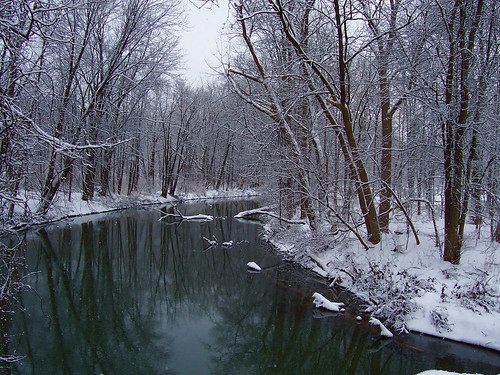
By lunch time, I was just coming to the realization that four hours of sleep is not enough for a woman my age. But we brushed aside the sleepiness with a hike in the woods, walking through about six inches of fresh snow that had fallen the night before while we were busy with massages and conversation. Puffy clumps of snow decorated the bare branches in the woods, and three of my friends could not resist beginning a snowball fight. We hiked to a grove of hemlocks, and Quilt Artist kept looking up at the branches above us, saying, "See, I could use that pattern for a quilt."
As we walked back to the house for another meal, a valiant attempt to finish up the leftover food, Makes Bread and Quilt Artist stopped to make angels in the snow.

That's why it's become a February tradition for my Wild Women friends to have a pajama party. Slumber parties, we decided a few years ago, should not be reserved for the junior high crowd. Women of all ages need giggling and dancing and chocolate to ward off those February blues.
We gathered yesterday evening, each woman following the long-established tradition of bringing way too much food. Both the counter and table were soon filled with veggies and dips and salads and sushi, enough food to last us about a week, rather than the 24 hours we actually had. It's hard to feel blue when I am surrounded by close friends, with a bowl of hot soup in my hands and guacamole at my elbow, and the sound of laughter rising above the crackling of the fire.
In the long-respected tradition of slumber parties across the country, we stayed up late, talking and eating, dressed in flannel and fleece. I am pledged to secrecy as to what exactly went on during those late night hours. ("Did you dance naked?" one of the husbands sometimes asks, with this sort of hopeful tone in his voice.) And in the morning sunshine, we stayed by the fire for hours more, still in our pajamas, carrying through with some of the deep conversations from the night before.
By lunch time, I was just coming to the realization that four hours of sleep is not enough for a woman my age. But we brushed aside the sleepiness with a hike in the woods, walking through about six inches of fresh snow that had fallen the night before while we were busy with massages and conversation. Puffy clumps of snow decorated the bare branches in the woods, and three of my friends could not resist beginning a snowball fight. We hiked to a grove of hemlocks, and Quilt Artist kept looking up at the branches above us, saying, "See, I could use that pattern for a quilt."
As we walked back to the house for another meal, a valiant attempt to finish up the leftover food, Makes Bread and Quilt Artist stopped to make angels in the snow.
February 15, 2008
February 14, 2008
River birch in February
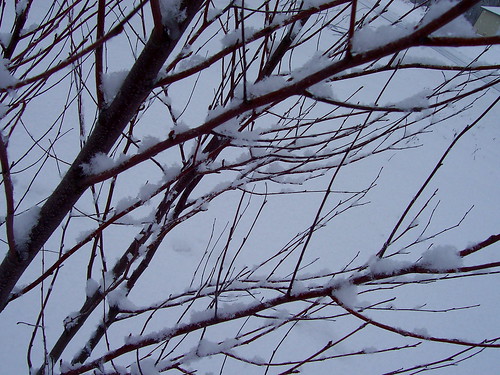
These branches belong to the river birch I planted in my front yard last May. I've planted all kinds of trees and bushes since we moved into this house eight years ago, and each tree reminds me of a particular spring, of feelings associated with the ritual of planting a tree. Or more accurately, the trees represent the introspective thoughts that I have each February, which is when I begin to tire of the cold weather and, looking forward to the warm gardening days of May, began planning what I want to plant that year. When I planted this river birch last May, I was thinking about a friend who was going through a difficult time, a friend whose life was about to unravel in dramatic ways.
I chose to plant a river birch (betula nigra) because river birches are survivors.
I've seen river birches flattened to the ground under ice storms, branches glistening and heavy to the point of breaking, and then I've watched those trees spring back, unharmed, in afternoon sun. The trees may look fragile, but those flexible trunks can handle stormy weather. The high winds that send the scotch pines toppling down don't hurt a river birch at all. I've seen river birches growing in heavy clay soils, which many trees can't handle, and I've seen them survive in standing water, at the edges of lots or streams.
The bark of the river birch, as the tree matures, will curl up and pull away, like a snake shedding its skin in a ritual of transformation. The rough edges of the bark, the scars and torn pieces, and the vulnerable pink smoothness beneath make each tree unique and beautiful.
This tree grows near my driveway, the first thing I see when I arrive home at the end of a day. During the hot months of July and August, I unraveled a long hose from the side of my house and watered the new river birch, letting the spray touch the slender branches, the green leaves. Standing in the dappled, shifting shade, I held the nozzle of the hose to the ground until the roots were completely saturated. During October, I watched as the leaves turned bright yellow and fell quickly to the ground, leaving only thin, bare branches.
In the snowy February yard, the tree looks small compared to the woods around us, the branches still just twigs, really. We've got weeks and weeks of snow ahead of us, too, that heavy wet snow that comes from fronts moving across the great lakes, the stormiest part of the winter. Ice and snow will bend the tree close to the ground, testing the flexibility and strength of the limbs.
But I have no doubt that this tree will survive. And when spring comes, and the green leaves began to come out again, the tree will grow anywhere from three to five feet, a rapid maturation. In only a few years, the tree will stretch higher than my house.
Because that is what river birches are most known for. Growth.
February 13, 2008
Street edge
My daughter, a magazine journalism student, is always writing and editing stories for her classes and for campus magazines. It's fun to listen to her talk about her writing — what angle she's going to take, what she is going to emphasize. Last week, her assignment was to interview someone from the local community for her travel writing class. The rule was that she couldn't talk to anyone connected to the university. The teacher wanted students to go beyond campus.
Of course, Wonderful Smart Beautiful Daughter has lived here her whole life so, unlike many of her classmates, she knows all kinds of people in the community. She has all kinds of contacts.
"But I didn't want to do anything with a public official," she told me later. "And I didn't want to talk about snow."
She paused. "Or salt. Or the canal. Or the mall."
Those stories have all been done before.
On the way to my daughter's off-campus apartment, right near the ramp coming off the highway, a homeless man often stands with a big sign that reads, "God Bless You." The on-ramps and off-ramps are popular places for street people to beg for money; when the light is red, they have a captive audience.
My daughter decided that a person who lived on the streets of Snowstorm City might best the best person to interview for her story. She parked at a gas station and watched Man With God Bless You Sign for almost two hours. "It seemed weird at first," she said, "like .... was I just going to go up to a stranger and say, hey, can I talk to you?"
But finally she just walked up to him and said, "Hey, want to go get something to eat?" and gestured towards the gas station. He smiled and said, "That would be nice."
"And after that, it felt normal," she said. "Once we started talking, it was fine." She introduced herself and told him that she was a student at the university. They went into the gas station and bought coffee, chips, cigarettes, and hot cocoa. ("Nothing nutritious?" I asked. She laughed. "I kept asking him that too, and then he kept saying to me, 'Are you sure you aren't hungry?'")
It was a cold day, so they sat inside her car and talked. He pointed out the other street people. He said he knew which ones were really homeless and which were not. One man had a disability and slept under the bridge at night. But then he pointed out one man who isn't really homeless. His wife has a job, and when he makes about $40, he give her $5, and then spends the rest on alcohol.
Then he told his own story. He'd been in prison, he said. For two years. He was with his cousin when the cousin was stealing tools from a high school tool shed. He was just an accomplice, he said, but he already had a record, so he went to prison. Before prison, he had family and friends.
When he got out, he had no one.
After talking for awhile, my daughter asked Man With God Bless You Sign if he needed a ride, and then drove him to the next place he wanted to be. When she said goodbye, he said, "If you ever want to come and hang out, you know where to find me."
Of course, Wonderful Smart Beautiful Daughter has lived here her whole life so, unlike many of her classmates, she knows all kinds of people in the community. She has all kinds of contacts.
"But I didn't want to do anything with a public official," she told me later. "And I didn't want to talk about snow."
She paused. "Or salt. Or the canal. Or the mall."
Those stories have all been done before.
On the way to my daughter's off-campus apartment, right near the ramp coming off the highway, a homeless man often stands with a big sign that reads, "God Bless You." The on-ramps and off-ramps are popular places for street people to beg for money; when the light is red, they have a captive audience.
My daughter decided that a person who lived on the streets of Snowstorm City might best the best person to interview for her story. She parked at a gas station and watched Man With God Bless You Sign for almost two hours. "It seemed weird at first," she said, "like .... was I just going to go up to a stranger and say, hey, can I talk to you?"
But finally she just walked up to him and said, "Hey, want to go get something to eat?" and gestured towards the gas station. He smiled and said, "That would be nice."
"And after that, it felt normal," she said. "Once we started talking, it was fine." She introduced herself and told him that she was a student at the university. They went into the gas station and bought coffee, chips, cigarettes, and hot cocoa. ("Nothing nutritious?" I asked. She laughed. "I kept asking him that too, and then he kept saying to me, 'Are you sure you aren't hungry?'")
It was a cold day, so they sat inside her car and talked. He pointed out the other street people. He said he knew which ones were really homeless and which were not. One man had a disability and slept under the bridge at night. But then he pointed out one man who isn't really homeless. His wife has a job, and when he makes about $40, he give her $5, and then spends the rest on alcohol.
Then he told his own story. He'd been in prison, he said. For two years. He was with his cousin when the cousin was stealing tools from a high school tool shed. He was just an accomplice, he said, but he already had a record, so he went to prison. Before prison, he had family and friends.
When he got out, he had no one.
After talking for awhile, my daughter asked Man With God Bless You Sign if he needed a ride, and then drove him to the next place he wanted to be. When she said goodbye, he said, "If you ever want to come and hang out, you know where to find me."
February 12, 2008
February 10, 2008

February 09, 2008
Block this!
Years ago, when I first began going to conferences by myself, I found that traveling on my own also meant sometimes walking alone in an unfamiliar city. I loved these opportunities to explore a city by myself, but I wanted to do something to make that experience safer. So I signed up for karate lessons.
I went three times each week, very early in the morning, to a dojo near my house. The dojo had a shining hardwood floor and huge floor-to-ceiling mirrors. I'd take off my shoes when I came in, go to the dressing room to change into my white gi, and then take a spot, sitting cross-legged on the floor. The class was small, about eight people at that time of day, and I was the only woman.
Mr. Macho, the guy who owned the dojo, was the younger brother of someone I'd gone to high school with. He was apparently quite good at karate tournaments. When he came into the dojo, all the students would bow to him, calling him "Sensei," and acting like he was royalty or something. I had a hard time conjuring up the proper subservient attitude toward him: to me he was still someone's snot-nosed kid brother. His wife ran the office, doing the administrative work of the dojo, and when she was in, I'd go chat with her, she's tell me funny stories about what it was like to live with Mr. Macho, and we'd both get into fits of giggles. When I came out of the office, the other men would look at me suspiciously. "What are you two laughing about in there?"
I liked karate right from the start. The katas were lovely and graceful: all of us moving in the same way at the same time, and it did feel empowering to punch and kick. I'd never punched anyone before, or defended myself from a punch or kick, and it felt good to know that I could. Although I was the smallest person in the class, I'm strong for my size and I could do everything easily. And I had the advantage of having a female body: I was more flexible than anyone, even the blackbelts.
Sometimes I'd get tips from Mr. Macho. He knew what he was doing when it came to karate, but he wasn't a very deep thinker. Almost every week, he'd look at my long hair swishing all around as I did the katas (most of the men had shaved heads), and he'd say: "You should put your hair in a ponytail."
"But this is how I wear my hair in real life," I'd explain. "If someone attacks me on the street, I'm not going to have time to put my hair in a ponytail before I defend myself."
He'd watch me spar, and say, "Are you left-handed? How come your left hook is so much stronger than your right?"
I'd explain patiently. "No, I'm right-handed. But that means my right hand is valuable to me. I hit harder with my left because I'm less afraid of hurting it."
For the most of the exercises, we'd be told to choose partners. The men would always turn and look at me, waiting to see who I'd pick, as if being a woman gave me first dibs. I always chose the same guy. He was the least macho of the men and the smallest, which meant he was closest to my size. He also had the loveliest British accent. For months, I partnered with him, doing these oddly intimate stretching exercises. We'd sit on the floor, for instance, our legs opened and feet touching each other, and then hold hands and pull our bodies first one way, than the other.
We'd exchange just a sentence or two, but often they'd be revealing. I found out he had a wife, two small kids. I had been hoping, from his accent, that he was a British rock star or something cool like that, but one day he told me he was a college professor who taught computer science. A computer geek! It was such a letdown. And he continued to give me scraps of his life in an understated way. We'd be sitting on the floor stretching, and he'd say just one sentence. "I'm getting divorced" or "I've had a dreadful week."
It did give me confidence to learn karate, to learn how to eye a situation, figure out my best tactic, to practice blocking a kick or punch, to learn how to put a wristlock on someone much bigger than I was. No, I never turned into one of those people you see in the movies — able to fly into the air while simultaneously dodging swords and kicking five different enemies — but still I felt more confident about the strength of my own body. The men in the class, who all had way more experience than I did, were helpful, giving me tips and encouraging me.
"Punch harder!" Shaved Head would say, grinning after I'd just punched him in the stomach. "Pretend I'm someone who did you wrong." Of course, then when it was his turn to play the role of the attacker, he'd pause and push my hair tenderly off my shoulder before grabbing me and flipping me onto the floor.
Sometimes the instructor would try to give us lessons about the culture of karate. We'd gather on the hardwood floor, sitting cross-legged, and he'd stand at the front of the room. For all his karate expertise, it was obvious to me that he had no training as a teacher. He seemed always to be looking for canned answers.
For example, I can remember him asking, "Why do we bow to Sensei?"
Around me, the men sitting on the floor in their white uniforms chorused: "Respect." That was the standard one-word answer to anything the instructor asked. He nodded approvingly.
Then I spoke up. "I think who we bow to shows a lot about the values of a culture."
The men turned to look at me. I was the only one who ever answered with whole sentences. "Sensei could beat any of us in a one-on-one physical battle. That seems to be the reason everyone bows to him. Obviously, we live in a culture that values the ability to beat the hell out of someone."
By now, all the men were listening, and Sparring Partner With the Lovely Accent was trying hard not to grin. I continued, just to make my point. "If we lived in a culture that valued life – well, I've given birth four times. You'd all be bowing to me."
Sparring Partner laughed. As usual, my response seemed to cut the teaching session short, and soon we were back on our feet, kicking and punching each other.
Another time, the instructor tried to talk to us about the formal rituals that we were taught to observe in the dojo. "Why do we bow to each other? And use formal titles?"
Again, the men chorused, "Respect." They had that one-word answer down cold.
I spoke up. "I've got a theory about that." Sparring Partner, sitting cross-legged next to me in his white gi, caught my eyes.
"I think it's because we have a situation here in which men are paired up to do intimate exercises with each other. And men are culturally ingrained to feel uncomfortable with intimacy between two males. So we need these formalities — these rigid rules, these formal titles — to make that acceptable. Learning karate can be very sensual and the formalities are put into place to counter balance that."
My words were followed by a deep silence.
Sparring Partner turned to smile at me. Then Shaved Head spoke up. "How about we ... not let her answer any more questions?"
I went three times each week, very early in the morning, to a dojo near my house. The dojo had a shining hardwood floor and huge floor-to-ceiling mirrors. I'd take off my shoes when I came in, go to the dressing room to change into my white gi, and then take a spot, sitting cross-legged on the floor. The class was small, about eight people at that time of day, and I was the only woman.
Mr. Macho, the guy who owned the dojo, was the younger brother of someone I'd gone to high school with. He was apparently quite good at karate tournaments. When he came into the dojo, all the students would bow to him, calling him "Sensei," and acting like he was royalty or something. I had a hard time conjuring up the proper subservient attitude toward him: to me he was still someone's snot-nosed kid brother. His wife ran the office, doing the administrative work of the dojo, and when she was in, I'd go chat with her, she's tell me funny stories about what it was like to live with Mr. Macho, and we'd both get into fits of giggles. When I came out of the office, the other men would look at me suspiciously. "What are you two laughing about in there?"
I liked karate right from the start. The katas were lovely and graceful: all of us moving in the same way at the same time, and it did feel empowering to punch and kick. I'd never punched anyone before, or defended myself from a punch or kick, and it felt good to know that I could. Although I was the smallest person in the class, I'm strong for my size and I could do everything easily. And I had the advantage of having a female body: I was more flexible than anyone, even the blackbelts.
Sometimes I'd get tips from Mr. Macho. He knew what he was doing when it came to karate, but he wasn't a very deep thinker. Almost every week, he'd look at my long hair swishing all around as I did the katas (most of the men had shaved heads), and he'd say: "You should put your hair in a ponytail."
"But this is how I wear my hair in real life," I'd explain. "If someone attacks me on the street, I'm not going to have time to put my hair in a ponytail before I defend myself."
He'd watch me spar, and say, "Are you left-handed? How come your left hook is so much stronger than your right?"
I'd explain patiently. "No, I'm right-handed. But that means my right hand is valuable to me. I hit harder with my left because I'm less afraid of hurting it."
For the most of the exercises, we'd be told to choose partners. The men would always turn and look at me, waiting to see who I'd pick, as if being a woman gave me first dibs. I always chose the same guy. He was the least macho of the men and the smallest, which meant he was closest to my size. He also had the loveliest British accent. For months, I partnered with him, doing these oddly intimate stretching exercises. We'd sit on the floor, for instance, our legs opened and feet touching each other, and then hold hands and pull our bodies first one way, than the other.
We'd exchange just a sentence or two, but often they'd be revealing. I found out he had a wife, two small kids. I had been hoping, from his accent, that he was a British rock star or something cool like that, but one day he told me he was a college professor who taught computer science. A computer geek! It was such a letdown. And he continued to give me scraps of his life in an understated way. We'd be sitting on the floor stretching, and he'd say just one sentence. "I'm getting divorced" or "I've had a dreadful week."
It did give me confidence to learn karate, to learn how to eye a situation, figure out my best tactic, to practice blocking a kick or punch, to learn how to put a wristlock on someone much bigger than I was. No, I never turned into one of those people you see in the movies — able to fly into the air while simultaneously dodging swords and kicking five different enemies — but still I felt more confident about the strength of my own body. The men in the class, who all had way more experience than I did, were helpful, giving me tips and encouraging me.
"Punch harder!" Shaved Head would say, grinning after I'd just punched him in the stomach. "Pretend I'm someone who did you wrong." Of course, then when it was his turn to play the role of the attacker, he'd pause and push my hair tenderly off my shoulder before grabbing me and flipping me onto the floor.
Sometimes the instructor would try to give us lessons about the culture of karate. We'd gather on the hardwood floor, sitting cross-legged, and he'd stand at the front of the room. For all his karate expertise, it was obvious to me that he had no training as a teacher. He seemed always to be looking for canned answers.
For example, I can remember him asking, "Why do we bow to Sensei?"
Around me, the men sitting on the floor in their white uniforms chorused: "Respect." That was the standard one-word answer to anything the instructor asked. He nodded approvingly.
Then I spoke up. "I think who we bow to shows a lot about the values of a culture."
The men turned to look at me. I was the only one who ever answered with whole sentences. "Sensei could beat any of us in a one-on-one physical battle. That seems to be the reason everyone bows to him. Obviously, we live in a culture that values the ability to beat the hell out of someone."
By now, all the men were listening, and Sparring Partner With the Lovely Accent was trying hard not to grin. I continued, just to make my point. "If we lived in a culture that valued life – well, I've given birth four times. You'd all be bowing to me."
Sparring Partner laughed. As usual, my response seemed to cut the teaching session short, and soon we were back on our feet, kicking and punching each other.
Another time, the instructor tried to talk to us about the formal rituals that we were taught to observe in the dojo. "Why do we bow to each other? And use formal titles?"
Again, the men chorused, "Respect." They had that one-word answer down cold.
I spoke up. "I've got a theory about that." Sparring Partner, sitting cross-legged next to me in his white gi, caught my eyes.
"I think it's because we have a situation here in which men are paired up to do intimate exercises with each other. And men are culturally ingrained to feel uncomfortable with intimacy between two males. So we need these formalities — these rigid rules, these formal titles — to make that acceptable. Learning karate can be very sensual and the formalities are put into place to counter balance that."
My words were followed by a deep silence.
Sparring Partner turned to smile at me. Then Shaved Head spoke up. "How about we ... not let her answer any more questions?"
February 08, 2008
February 07, 2008
Ritual
I like to go back to the same places again and again, doing the same things over and over, until my feelings are embedded in the landscape. The spectacular clear water of Pretty Colour Lake, for instance, holds many of my brooding thoughts, my sad moments, my dreams and crazy ideas. Hundreds of times over the last 46 years, I've walked the trails by myself, deep in my own thoughts, or circled the lake with a friend or family member important to me. Some of my earliest childhood memories are of the traditional fall leaf-gathering picnic with my family and Picnic Family at Pretty Colour Lake, and those memories hug me when I walk by myself.
I have a group of friends — the ones I call the Wild Women — who are equally fond of rituals. We sometimes gather for a full moon ceremony. We've celebrated marriages and divorces as well as births; we've many times burned tobacco ties in the ritual of release. We go off to the mountains together the same weekend every year, to a place where we have a chance to walk a labyrinth, which is a walking meditation. I have other friends I go to a monastery with, and they too share my respect for tradition. Twice each year, we go to the same monastery, that cluster of buildings high in the hills, bringing with us the same food, the same books, the same faults and issues and struggles. And I love the rituals of the monastery, the group of monks gathering for prayer seven times each day, every day, all year long. I love the incense, the chanting, the psalms.
I have celebrated both winter and summer solstices with PlantsWoman, who always has a bonfire for a solstice, and whose rituals include storytelling. My extended family has so damned many traditions that holiday gatherings are days long, filled with rituals that extend from musical performances to fishing for popcorn balls behind my parents' couch. And in my home, we've created our own rituals, like the candle ceremony for birthdays, a ritual in which we gather in a dark room with candles and each say something nice about the person who is having the birthday. Some of my rituals are borrowed from the native people in this area, some come from my own upbringing as a Catholic, a religious tradition that is steeped in ritual, and most involve some kind of natural element, especially fire. I do so love to burn things.
In a book I read recently, Eat, Pray, Love by Elizabeth Gilbert, I came across a wonderful description of what a ritual can do.
"We do spiritual ceremonies as human beings in order to create a safe resting place for our most complicated feelings of joy or trauma, so that we don't have to haul those feelings around with us forever, weighing us down. We all need such places of ritual safekeeping. And I do believe that if your culture or tradition doesn't have the specific ritual you're craving, then you are absolutely permitted to make up a ceremony of your own devising, fixing your broken-down emotional system with all the do-it-yourself resourcefulness of a generous plumber/poet. If you bring the right earnestness to your homemade ceremony, God will provide the grace."
Exactly.
I have a group of friends — the ones I call the Wild Women — who are equally fond of rituals. We sometimes gather for a full moon ceremony. We've celebrated marriages and divorces as well as births; we've many times burned tobacco ties in the ritual of release. We go off to the mountains together the same weekend every year, to a place where we have a chance to walk a labyrinth, which is a walking meditation. I have other friends I go to a monastery with, and they too share my respect for tradition. Twice each year, we go to the same monastery, that cluster of buildings high in the hills, bringing with us the same food, the same books, the same faults and issues and struggles. And I love the rituals of the monastery, the group of monks gathering for prayer seven times each day, every day, all year long. I love the incense, the chanting, the psalms.
I have celebrated both winter and summer solstices with PlantsWoman, who always has a bonfire for a solstice, and whose rituals include storytelling. My extended family has so damned many traditions that holiday gatherings are days long, filled with rituals that extend from musical performances to fishing for popcorn balls behind my parents' couch. And in my home, we've created our own rituals, like the candle ceremony for birthdays, a ritual in which we gather in a dark room with candles and each say something nice about the person who is having the birthday. Some of my rituals are borrowed from the native people in this area, some come from my own upbringing as a Catholic, a religious tradition that is steeped in ritual, and most involve some kind of natural element, especially fire. I do so love to burn things.
In a book I read recently, Eat, Pray, Love by Elizabeth Gilbert, I came across a wonderful description of what a ritual can do.
"We do spiritual ceremonies as human beings in order to create a safe resting place for our most complicated feelings of joy or trauma, so that we don't have to haul those feelings around with us forever, weighing us down. We all need such places of ritual safekeeping. And I do believe that if your culture or tradition doesn't have the specific ritual you're craving, then you are absolutely permitted to make up a ceremony of your own devising, fixing your broken-down emotional system with all the do-it-yourself resourcefulness of a generous plumber/poet. If you bring the right earnestness to your homemade ceremony, God will provide the grace."
Exactly.
Subscribe to:
Posts (Atom)