September 30, 2007

Change in plans

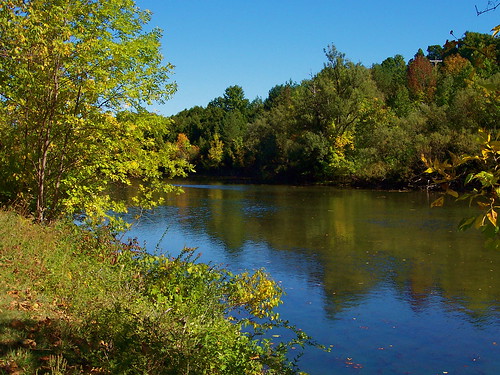
From our window

Friday morning, I arrived at my parents' house bright and early to drive them to the mountains. Their bags were packed and sitting under the picture window near the front door. My mother, who opened the door, was dressed to go, even wearing her fleece. But my father, just minutes before, had gotten suddenly sick, down with some kind of stomach virus that left him vomiting and nauseous, unable to travel. It had happened very fast, all in the few minutes that it takes for me to drive from my home to theirs.

We were all disappointed, but at least it was just a simple virus and not something more serious. My father is 76 years old, so his continued good health is not something any of us take for granted. Since I'd already paid for the rooms at the inn we were staying at, my mother and I began brainstorming for plan B. She didn't want to leave my father, so her coming was not an option. But she didn't want the rooms at the inn to go to waste. I called my husband to ask if he wanted a spontaneous trip to the mountains.

We made arrangements fast. My husband maneuvered things at work so that he could be done by 3 pm, which would get us to the inn before dark. My oldest two kids were out of town, Boy in Black at an Ultimate Frisbee tournament and my daughter visiting friends, but First Extra was willing to help out. He would pick With-a-Why up at school, take him to his piano lesson, pick up Shaggy Hair Boy, take him to his piano lesson, and the circle back again to take Shaggy Hair to his guitar lesson. Neighbor Woman said that the two boys could sleep at her house, home to Older Neighbor Boy and Philosophical Boy, and she invited Skater Boy to join them as well. After just a few phone calls, everything was in place, and by late afternoon, my husband and I were driving to the mountains for a romantic weekend that came as a bonus.

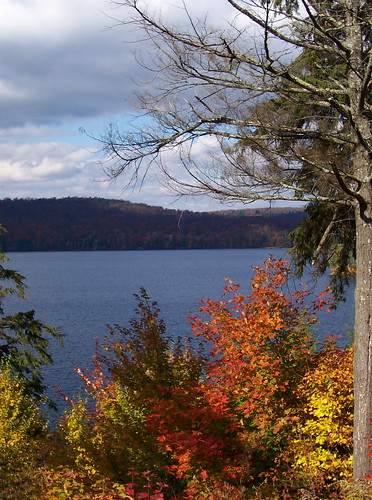
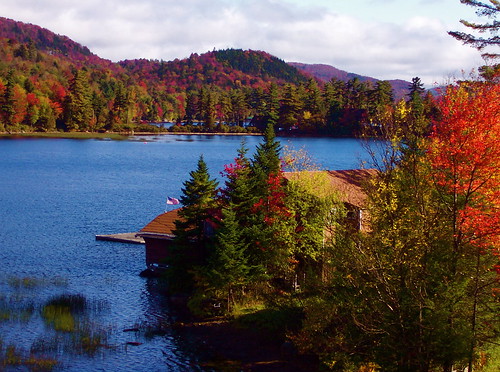
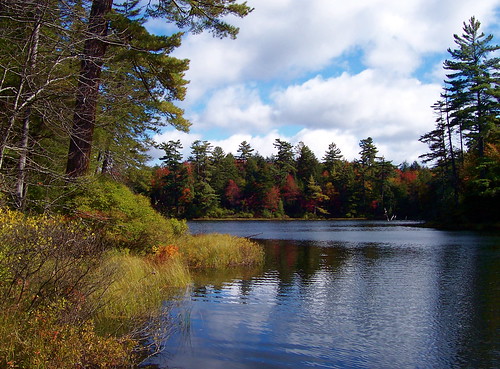
The weather was changeable as we drove through both rain and sun, but as soon as we hit the higher elevations, we could began seeing the fall colours in the trees along the road. For sheer beauty, it would be hard to beat the mountains in autumn. The winding mountain road led us past small lakes, stands of pine trees, and maple trees that burst with red and gold. By the time we pulled into the old mountain inn on Large Ungulate Lake, we were both hungry and ready for a leisurely dinner in the restaurant that overlooked the lake.

Of course, I'd packed for a weekend with my parents and not my husband, which mean that my overnight bag contained papers to grade rather than lingerie, a discovery which led to all kinds of jokes that I cannot repeat on this kind of blog. Our room looked out over the lake, lit only by moonlight. Most of the summer camps on the lake are dark and quiet in the fall, although light spilled across the porch from the inn's restaurant, which was filled with laughing, talking patrons.

Saturday, we woke to a blue and gold autumn day, cool enough for long pants and a fleece. We hiked around one of our favorite lakes and found a bridge where we could sit in the sun and talk. Always, it is wonderful to leave behind the everyday world of work, papers, computers, email, telephone calls, and tight schedules. We talked about childhood memories and landscapes we love, and about how difficult it is to let go as our children turn into young adults. We took off our socks and hiking boots to put our feet into the icy cold mountain lake.

By lunchtime, we'd visited a few of the places I usually go to with my parents: the resort on the lake, the public dock on Numbered Lake, some short hiking trails. A strong, cold wind was blowing across the lake, so we stopped in town to buy some homemade pie, and hiked into a bog, which I knew would be warm and sheltered. The boardwalk kept us high and dry, and soon we were both lying down in the sun, using our rolled-up sweatshirts as pillows and taking a peaceful nap in the sun. The busy, stressful world of fall semester seemed miles and miles away.
From the bridge

September 27, 2007

Days gone by

Days gone by

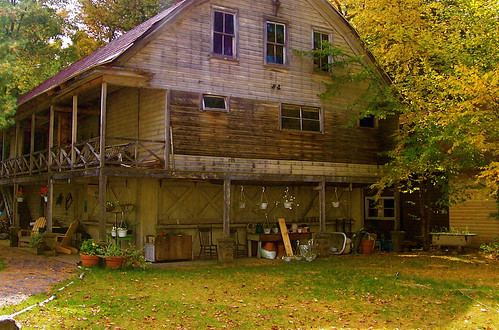
My father calls this building "The Casino." It's old now, and it hasn't been kept up, but it's still standing at the edge of a lakefront resort in the mountains. When my father looks at the building, he can still picture those evenings in the 1950s, when the guests at the resort would dress up in their evening finery and come out to the casino to drink and dance and flirt. My father was a musician who worked at the resort, playing every evening, and then hanging out with the rest of the staff in the early hours of the morning.

Every year in the fall, I drive with my parents to the mountains, and we visit my father's old haunts. We hike along trails that edge mountain lakes, wander through resorts, some of which have long since closed, and visit the little mountain towns where he spent so much time in the summer as a young man. We'll stay at an old mountain inn, a cosy place with a big fireplace and cups of mulled cider for all who enter. We'll drive through winding roads lined with bright foliage and dark pines on this fall pilgrimage to the mountains.

Fall

September 26, 2007

Instead

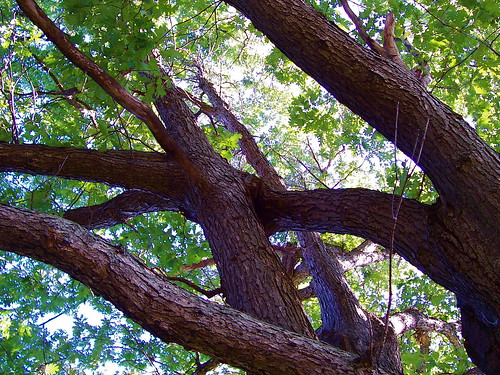
On a day when I am sitting at my desk all day, grading papers, sorting through piles of stuff on my desk, and feeling overwhelmed by the to-do list that gets longer every time I check my email, I can't help but think of places where I'd rather be. Walking along the shore in a light rain. Riding a raft through a rapid on the Colorado River. Sailing on the river. Paddling through a marsh in a red canoe. Lying in a hammock and looking up into the branches of an old oak tree.

Looking up

September 25, 2007

Devotion to the disc

Disc

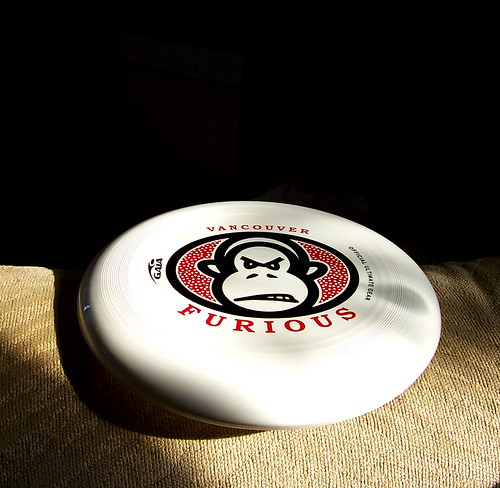
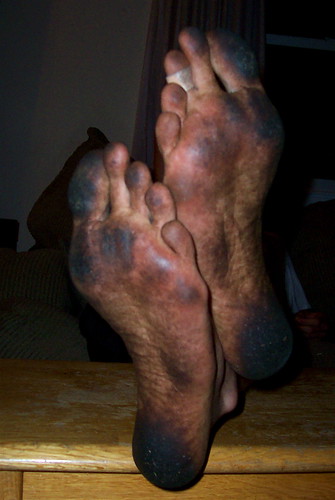
All summer, Boy in Black devoted his energy to getting together enough people for a game of Ultimate Frisbee. That's what he did pretty much every day. Since few of the kids who come here own cleats, they all play barefoot, and Boy in Black's dedication to the sport of Ultimate is such that his feet were black with dirt and wear for most of the summer. (Even though I keep using the word frisbee, Boy in Black tells me that the round object is really supposed to be called a disc.)

Now that he's back at college and playing with the team again, Ultimate is pretty much all Boy in Black talks about. I keep hoping that maybe he's learning something from his classes or his interactions with professors and other students, but mostly it seems that he is spending his time honing his Ultimate Frisbee skills. Even when he's home, which is fairly often, he will talk his brothers or some of our extras into going out to the field across the street to practice. Starting this weekend, he'll be going to tournaments, traveling about with the team.

Last weekend, I came home in the evening to see Boy in Black over in the kitchen area, washing dishes. He'd been out in the field earlier with his brothers. I felt impressed that he was willing to jump in and help out with the chores, even though he doesn't live here during the semester. I walked over to say something nice to him, and then noticed that the round flat objects he was washing so carefully weren't china dinner plates. They were frisbees.

He looked up and explained, "The discs get covered with poison ivy. You can't be too careful."

The feet of an Ultimate Frisbee player

Boy in Black's feet after playing a barefoot game of Ultimate.

ETA: For those of you who haven't ever seen Ultimate played, Boy in Black recommends this video.

September 24, 2007

Just in case

In my efforts to get my friends to procrastinate in the same ways I do, I have sucked yet another person into blogging: Kindergarten Friend. I've written about her before on my blog – we've been friends since we met in kindergarten over forty years ago. Since we've both chosen to stay in Snowstorm Region, we still get to see each other in person. She is one of the few people I know in real life who reads my blog: she has been known to leave comments saying things like, "Yep, it's all true. Jo(e) really is crazy." And of course, she is the friend who went to Club Libby Lu as a spy, which makes her responsible for about half of all the hate mail I get.

It's fun that now when we talk on the phone we can talk about blogging. Here, for example, is a bit of our conversation from the last time we talked.

Me: Hey, now that you blog, you can be the person who tells all my blogging friends if I'm dead.
KF: What?
Me: Well, it seems to happen all the time.
Me: Bloggers stop blogging, just disappear, and you never know what happened to them.
KF: Oh, so you assume that they got hit by a truck or something.
Me: Exactly.
Me: If I get hit by a truck and killed instantly, I want my blogging friends to know.
KF: Well, if that happens, I can write something for your blog.
KF: I'd be happy to.
KF: I mean, after I stop crying and all that.
Me: Oh, yeah, you can have a day or two to grieve.
Me: I'll give you my password now just in case.
KF: Okay, let me grab a pen.
Me: Oh, you won't have to write it down.

I rattled off a bunch of numbers. She laughed.

What might be random numbers to anyone else are not at all random to two people with a shared history.

KF: I think I can remember that.
Me: And my username is "writingasjoe."
KF: Got it.
Me: I am sure my readers will be happy to know we have a plan in place.

September 23, 2007

Goldenrod and asters

My husband and daughter flew this weekend to Big Midwestern City With the Baseball Team That is Famous For Losing. The trip, they told me, was all about my daughter visiting Grad School Where Urban Sophisticate Learned to be a Reporter. It was about father/daughter bonding time. Really, the trip was for educational purposes and for strengthening their relationship. And coincidentally, as an afterthought really, they just happened to have expensive hard-to-get tickets for three baseball games.

Meanwhile, I had a lazy weekend home with the boys. On Saturday, I took them out to Pretty Colour Lakes, where With-a-Why, Shaggy Hair Boy, and Philosophical Boy spent their time trying to skip stones on the water's surface. It was a lovely evening to be outside. The sun lit up the cedar trees on the other side of the lake, whose waters were shining deep green. When Boy in Black and Skater Boy joined us, the boys took over the empty beach and tossed the frisbee around until after dark. First Extra was just pulling into the driveway when we got home, and the rest of the evening was devoted to music, chatter, and the game Scattergories.

Today was another sunny fall day, and my mother called in the morning to see if we wanted to go on a picnic. After consulting with the boys, I called her back, but no one answered. For the rest of the morning, I called repeatedly. I was reading aloud to With-a-Why and we'd hit an exciting part in the book, but we did stop at the end of each chapter to hit the redial button. But all I got was a dial tone. I decided then that some tragic accident had happened and both my parents were dead. Or perhaps something was wrong with their phone. Eventually, after With-a-Why and I had finished the book, I drove to their house. They had just finished eating lunch, happily oblivious to the fact that I'd been calling. They turned the phone off when they were watching a television show the other night and then just forgot all about it. "I wondered why we hadn't gotten any calls this week," my mother said.

The sun was still shining, so we took a walk along the canal, on a flat gravel path that was once the towpath. Asters and goldenrod bloomed along the edges. My father, predictably, was filled with facts and stories about the canal. He kept describing to the boys what it must have been like to travel along the canal by boat. My mother pointed out the wild grapes growing along the edge of the canal. Shaggy Hair picked some and made us eat them: the grape he gave me was so sour that I spit it out. An older man was sitting on the stones at the edge, fishing, and farther along, we saw a little boy with his fishing pole and his mother. Several times, we heard calls of "on your right" and bicyclists went zooming by. We saw young people running, parents pushing strollers, and several people walking their dogs. A whole flock of geese swam along on the surface of the water, amidst the floating leaves. Creatures of all types seem to be enjoying the lazy sunny afternoon.

Along the canal

September 22, 2007

Bits and pieces

Out the window

With-a-Why is a quiet, serious child, the youngest in a noisy, chaotic household. Most of my conversations with him take place during bits of time sandwiched between other events of the day, during those odd moments when he and I are alone together. Yesterday morning, for instance, he sat next to me in the waiting room at the orthodontist's office and read over my shoulder while I wrote a blog post on my laptop. He loves to point out typos. And we talked that afternoon on the way to his piano lesson. Here are a few topics we covered during the ten-minute drive from the junior high building to the music studio.

With-a-Why: You know that blog post you were writing at the orthodontist's this morning?
Me: Yeah.
With-a-Why: Did you put it up already?
Me: Yeah. When I got home.
With-a-Why: I was thinking. You should have started out with the tips you were giving your students for the introductions, like "Be vague and general." Then people would have been like, oh, she sucks as a teacher. And then you could have said you were having them write bad introductions on purpose.
Me: Yeah, that would've been a better approach.
With-a-Why: It would've been a better introduction.

Me: You need to wash your hair tonight.
With-a-Why: Why?
Me: So it'll be clean.
With-a-Why: Why does that matter?
Me: Because if you don't take showers and wash your hair, you'll smell.
With-a-Why: So what if I smell? It will protect me from predators.
Me: But you're a human.
With-a-Why: (Shrugs.)
Me: And humans are social beings. You live in the human world.
With-a-Why: The world doesn't belong to the humans. That's a ridiculous thing to say.
Me: Anyhow, predators use smell to find their prey. I think a strong smell would be a bad thing.
With-a-Why: What about sow bugs?
Me: Sow bugs?
With-a-Why: Or skunks. Some animals use smells to ward off predators.
Me: But humans don't.


With-a-Why: Do they dissect animals at Small Green College?
Me: What?
With-a-Why: Do they dissect animals?
Me: Uh, yeah. In the labs. In courses like zoology.
With-a-Why: Do they kill them or do they use animals already dead?
Me: Well, sometimes it's roadkill. Whenever my students see a dead animal on the road, they put it in their freezer.
With-a-Why: But do they buy animals to kill?
Me: Well, I think they must.
With-a-Why: We're supposed to do dissections in science next year. For eighth grade.
Me: I remember that when Red-haired College Roommate went through medical school, she had to dissect humans.
With-a-Why: That's different.
Me: What do you mean?
With-a-Why: The humans have agreed to donate their bodies.
With-a-Why: And when humans agree to donate their bodies, it doesn't happen until after they've died of something else. They don't agree to be killed.
Me: Yeah, that's true.
With-a-Why: Well, I am not going to do dissections. It's wrong.
With-a-Why: The animals didn't agree to be killed.
Me: Well, they can't make you do something you think is wrong.
Me: Just make sure you are prepared to explain why you think it's wrong.
With-a-Why: Well, it's sort of obvious.
Me: Not everyone thinks like that.
With-a-Why: Did you do a dissection?
Me: In high school, I did.
Me: The fetal pig was kind of creepy. It looked kind of human inside.
With-a-Why: Would you do one now?
Me: Well, I would with roadkill or something like that.
Me: Dissections can be fascinating.
With-a-Why: Not for the animal being dissected.

September 21, 2007

The modern world of today

"So tell me, " I said to my first year students in class yesterday, "What do I need to do to write a bad introduction?"

They looked puzzled at first, but a few students understood what I was doing and jumped in with ideas, and the rest of the class followed. Soon they were all shouting out suggestions. Be really general and abstract! Use big, abstract words, but say nothing. Use cliches! Quote the dictionary. Use a cliche but put it in quotes as if that somehow makes it better. Don't ever get to your point. Be vague. Be irrelevant. Don't vary your sentence structure! Don't include any interesting details. Use tired old phrases. Write confusing, convoluted sentences. Be redundant. Above all, be boring.

Then I put the students in pairs, gave them a topic — violence on television — and told them that they need to write a bad introduction, using all that we had talked about. They set to the task eagerly, with me spurring them on, "Use another cliche! Be boring!" This exercise always brings chatter and laughter as they brainstorm ways to write badly.

The best students, not surprisingly, wrote the worst introductions. One enterprising duo managed to use the phrase "in the modern world of today" four times. Another introduction began with the sentence, "Throughout history, television has always been part of history." Of course, they couldn't resist exaggerating the paragraphs to the point where they became funny and interesting, a parody of bad writing rather than bad writing itself. Read aloud, they weren't mediocre and boring, but hilariously funny. As we went around the room, reading them aloud, everyone laughed and clapped at the best ones – or should I say the worst ones?

We analyzed what was especially bad about each introduction, labeling certain practices as "classically bad." Most of us have that kind of stuff in our first drafts, I told them. The key is to notice it, and edit it out.

I know from experience that this exercise works. Once you've read a whole bunch of dreadfully bad introductions, you can't help notice that kind of stuff in your own writing. For the rest of the class period, we were workshopping drafts of an essay that's due next week, and I heard many students say, "I need to rewrite this introduction." One student, grinning, showed me his essay, pointing to the very first sentence where he had crossed a phrase out with bold black pen: "In the modern world of today."

September 19, 2007

And a star to steer her by

Building

During the winter of 65-66, my father began building a boat in his basement. I was a tiny kid, not yet in kindergarten, and the 18-foot sailboat seemed huge to me as I watched it take shape. I wasn't allowed in the cellar when he was using power tools, although I could hear the familiar whine of the table saw from where I would be sitting up in the kitchen, eating or playing a game with my siblings. But when he wasn't using power tools, I could perch on the stairs and watch him work. He'd be marking pieces of wood with the flat pencil that he kept above his ear. The light bulbs on the cellar ceiling shone down on puddles of sawdust and scattered bits of wood.

When he was halfway through the project, my parents threw a boat-turning party. My father removed bunch of cinder blocks from the wall of the basement, and his friends carried the boat outside to turn it over and then carry it back in so he could finish the project. A newspaper reporter showed up at the party, and they ran a story about the man who built a boat in his basement and knocked a wall out so that he could get the boat out. I can remember even as a kid thinking that the story was a bit exaggerated: he'd planned all along to remove the wall.

And how exciting it was when we finally got to sail the boat. Well, come to think of it, the first half an hour wouldn't be exciting. My parents would tell us kids to stay in the cabin and keep out of the way, while they went through the hassle of raising the mast and figuring out where the ropes went. In the early days, this process was fraught with tension, since my parents didn't know yet how to sail: my father was learning from books he'd read, which is possibly not the easiest way to learn something like that. We kids would be huddled in the cabin, amidst the white duffle bags and orange life jackets, impatiently waiting for the moment when we could climb up and out the forward hatch and sit on the deck in the nice breeze.

But soon, my father had learned to sail, and some of us kids began learning too. In the summertime we sailed up on the river, where we went camping, and in the fall, we sailed on Big Lake Near Snowstorm City. I can still remember those fall afternoons when my father and I would drive out to the lake to the marina where he kept the boat. Whitecaps would kick up on gusty days, and other days, we would just ghost along with the slightest breeze. When we glided near shore, we'd hear the hum of chainsaws and smell fires burning autumn leaves. Mostly, it was just the two of us, although sometimes my brother came.

But wooden sailboats don't last forever, and after twenty years, dry rot spread through the hull of the sailboat. My father salvaged what he could, including the mast, the centerboard, and the rigging, and we had a boat burning ceremony in their backyard. The ceremony included dramatic readings from the ship's log, flowers presented and dropped down the hatch, and ended with an emergency call to the fire department. But that's another whole story.

Not deterred by the loss of his first boat, my father did something he'd been wanting to do: designed his own sailboat. He drew up the plans and built the boat during the winter of 85-86. I was, coincidentally, expecting my first child that June, and we decided to race to see who would get done first. When I went into labor, my husband and I went over to my parents' house, so that I could take a walk through the apple orchards behind their house. My father had the boat on the trailer and was just raising the mast for the first time, testing out the rigging and the sails.

The new sailboat was both fast and stable, with a centerboard that could be pulled up in the shallow marsh where my parents' camp is. For over twenty years, my father has sailed this boat on the River That Runs Between Two Countries. Early this summer, both the boat and my daughter turned 21. And in the boat, my father discovered rot. It was time, once again, to salvage what he could and re-design the whole boat. He ripped off the cabin, and set to work.

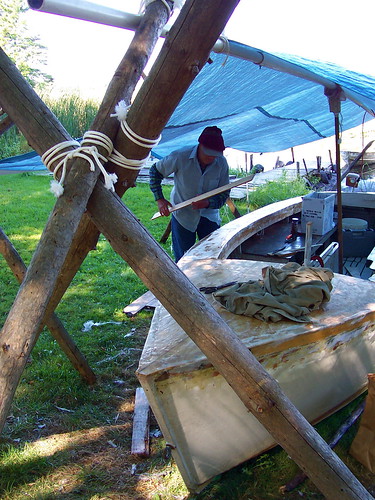
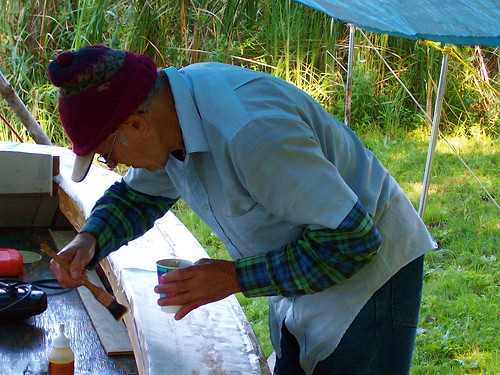
That's been my father's project for the last month or two. He's been working on the boat, not in his basement this time, but up at camp, since he no longer has a boat trailer. The temperature has to be high enough for fiberglass to set so he's been working furiously to get the boat done before the cold weather. He's 76 now, and he claims that he gets tired more easily than he used to, but you would never notice that if you watch him work. He's been doing carpentry so long – he built houses with his father when he was a kid – that building a boat is easy to him as walking is to most people.

He's had to battle the weather during this project: rain, heat, gale force winds. In some ways, working under a tarp at the edge of a river is the worst possible working conditions. Thunderstorms move quickly up the river, and rising winds can tear the tarp from its moorings. But on the other hand, he has also been working under the best possible conditions. The fresh clean air from the river sweeps away the smell of the fiberglass. The marsh provides music -- birdsong, frogs, the splash of turtles or fish. When he wants a break, he can retreat to the shady spot under the oak trees where my mother might be reading a book or working on some project of her own. And there's something satisfying about building a boat right at the edge of the water, just a few feet from the dock where it will be tied next summer, just yards from the river where he'll be sailing it.

Fiberglass

September 18, 2007

My woods

Woods

The rhythm of the household has shifted now that fall semester is underway. Teaching gives my life a structure: one day I get a quiet morning at home to work, the next day is filled with classes and meetings, the next day, another quiet morning at home. Because I'm an extrovert, I enjoy the busy days on campus. Teaching energizes me, forces me to think about issues larger than my personal life. But I also value the days when I'm at home, working at my desk, exchanging emails with friends, and eating lunch by myself at the round wooden table that looks out the big glass windows to the woods beyond the house.

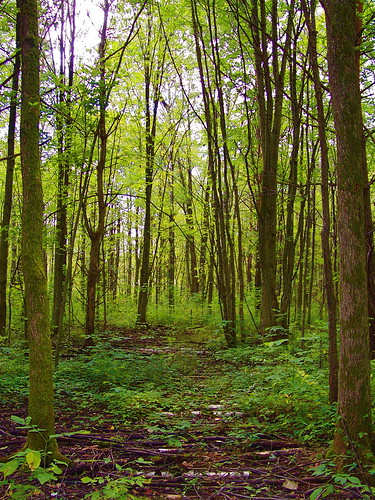
I don't go into my own woods much during the summer because the mosquitoes are fierce. But now that it's September, the bugs are gone, and I can walk amongst the trees behind my house without slapping at my arms constantly. I live in the sticks: a flat, wet landscape of young trees that grew up after some of the land had been logged or farmed, and groves of scotch pines planted by the CCC. There aren't any spectacular vistas or gorgeous lakes: just acres and acres of trees. Some of my trails follow old logging roads, others follow trails made by white-tailed deer. In a few more weeks, the foliage will turn spectacular shades of red and orange, but for now, the trees are mostly green and yellow and gold, the soft shades of early fall.