Spring and Fall: To a Young Child
Margaret, are you grieving
Over Goldengrove unleaving?
Leaves, like the things of man, you
With your fresh thoughts care for, can you?
Ah! as the heart grows older
It will come to such sights colder
By and by, nor spare a sigh
Though worlds of wanwood leafmeal lie.
And yet you will weep and know why.
Now no matter, child, the name:
Sorrow's springs are the same.
Nor mouth had, no nor mind, expressed
What heart heard of, ghost guessed:
It is the blight man was born for,
It is Margaret you mourn for.
Gerard Manley Hopkins
September 05, 2005


September 03, 2005
Packing the tent again
We are leaving in moments for camp, driving to the marsh I love, to the river I know best, to that peninsula of oak trees and grey rock set amongst acres of cattails. After my trip to the Southwest, I know that camp will seem lush and green. The mosquitoes should be gone for the season, so we will be able to sit around a campfire, telling stories. Boy in Black and my brother will bring guitars, and my Dad, his clarinet.
We'll be missing some of the grandchildren: Smart Beautiful Wonderful Daughter and Red-haired Niece are in college. Schoolteacher Niece is on her way to Big City Like No Other to begin her grad work.
The nights will begin to be chilly, temperatures dropping into the 40s and 50s. Acorns will begin falling from the oak trees. My Mom and I already have plans for an early morning canoe trip: the mist on the bay this time of year is always wonderful.
I have spent every Labor Day weekend at camp since 1968, and I know what I will find there. Peace and quiet. Time to think and reflect. Time away from media coverage of tragic events that make me both sad and angry. Time to pray for all those who can't spend the weekend in such a tranquil place.
We'll be missing some of the grandchildren: Smart Beautiful Wonderful Daughter and Red-haired Niece are in college. Schoolteacher Niece is on her way to Big City Like No Other to begin her grad work.
The nights will begin to be chilly, temperatures dropping into the 40s and 50s. Acorns will begin falling from the oak trees. My Mom and I already have plans for an early morning canoe trip: the mist on the bay this time of year is always wonderful.
I have spent every Labor Day weekend at camp since 1968, and I know what I will find there. Peace and quiet. Time to think and reflect. Time away from media coverage of tragic events that make me both sad and angry. Time to pray for all those who can't spend the weekend in such a tranquil place.
September 02, 2005
Student reactions
Usually during the first week of classes, the campus is filled with high spirits and lots of energy, but this week has been pretty somber. Here in the northeast, few of my students have any connection to New Orleans, but the media images have for many of them stirred up memories of September 11th. Many of them remember what it was like to have missing family, to lose contact with friends, to wait and hope desperately for a phone call that would tell them that someone they loved was still alive.
Many of my scientist students keep shaking their heads in disbelief, their logical minds trying to comprehend what is happening. "But everyone knew that this was coming, that a storm like this was inevitable. How is that the government had no plan to evacuate the poor, the elderly, the children? How could this happen? We had all the data we needed years ahead of time."
Even as my New York City students make the comparison to the World Trade Center coming down, the rural students express their frustration at how helpless they feel. "In a small town, you can help out when something happens. You let people sleep on your couch, you cook them up some good food, you let them chill at your house," said one of my small town students. "But all this is so far away. There is so little we can do."
And as the week went on, the anger was building - anger at the Bush administration. "Last November was so depressing," said one student, "but now .... this is even worse. Maybe it's because he is no longer running for election, but he is not even pretending to care. I am so angry I could puke."
Several times I heard: "I cannot believe this is happening here, in this country." Other students are not surprised. They seem resigned.
In one class, I had a student who said something like, "Well, people were stupid not to evacuate." I didn't even say anything; classmates were quick to question his statement. "How would you evacuate if you didn't own a car? What if you couldn't afford a hotel? What if you were elderly or sick? Yeah, you say just walk, but where would you walk to? And who can afford to evacuate every single time a storm comes?" Students were pretty quick to point out the privileges that come with race and class in this country, privileges that could mean life or death in a hurricane.
These conversations were the undercurrent of the week, during slow times in my office, during the sunny weather out on the quad, in the snack bar where I have breakfast, or during the ten minutes before class when I chat with the students as they arrive. Sadness, anger, disbelief. That is how this semester is beginning.
Many of my scientist students keep shaking their heads in disbelief, their logical minds trying to comprehend what is happening. "But everyone knew that this was coming, that a storm like this was inevitable. How is that the government had no plan to evacuate the poor, the elderly, the children? How could this happen? We had all the data we needed years ahead of time."
Even as my New York City students make the comparison to the World Trade Center coming down, the rural students express their frustration at how helpless they feel. "In a small town, you can help out when something happens. You let people sleep on your couch, you cook them up some good food, you let them chill at your house," said one of my small town students. "But all this is so far away. There is so little we can do."
And as the week went on, the anger was building - anger at the Bush administration. "Last November was so depressing," said one student, "but now .... this is even worse. Maybe it's because he is no longer running for election, but he is not even pretending to care. I am so angry I could puke."
Several times I heard: "I cannot believe this is happening here, in this country." Other students are not surprised. They seem resigned.
In one class, I had a student who said something like, "Well, people were stupid not to evacuate." I didn't even say anything; classmates were quick to question his statement. "How would you evacuate if you didn't own a car? What if you couldn't afford a hotel? What if you were elderly or sick? Yeah, you say just walk, but where would you walk to? And who can afford to evacuate every single time a storm comes?" Students were pretty quick to point out the privileges that come with race and class in this country, privileges that could mean life or death in a hurricane.
These conversations were the undercurrent of the week, during slow times in my office, during the sunny weather out on the quad, in the snack bar where I have breakfast, or during the ten minutes before class when I chat with the students as they arrive. Sadness, anger, disbelief. That is how this semester is beginning.
September 01, 2005
High above the river
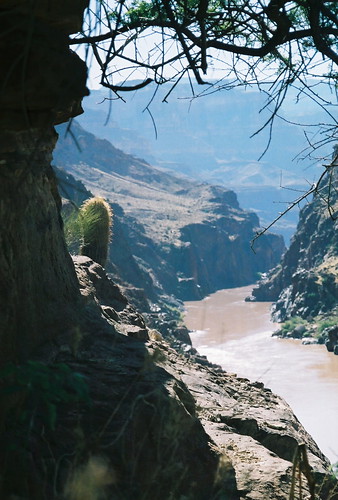
I am afraid of heights.
I rarely confront that fear unless I go to the Southwest, where hiking trails often include spectacular vistas that absolutely terrify me. Climbing mountains in the northeast never scares me because always we have trees and bushes. When I look down from a cliff and see treetops, I always feel reassured. Perhaps it is the admittedly irrational thought that somehow the trees would rescue me. Or perhaps it is just that trees and snow are what I'm used to.
On the first hike of this Grand Canyon trip, I announced my fear of heights to the other fourteen people and explained to them (a bit defensively) that the fear was not irrational in the least. Being afraid of heights makes sense! Without it, humans would be falling from cliffs and buildings all the time. Fear is a good thing. They all laughed at me and then assured me that they would get me through the difficult hikes.
And I did manage every hike that I wanted to do, even climbing along scary narrow ledges where there is nothing, NOTHING at all, to hold onto. Every time, someone was ahead of me to show me where to step or behind me offering encouragement, even if the encouragement sometimes came in the form of teasing.
"Why are you always touching the cliff walls?" one hiker asked as we walked along ledge so narrow that I had to stop and think where to put my feet. "Without a real handhold, those rocks are not going to help you. And for god's sake, don't try to hang onto a cactus."
But still, I continued touching the rock whenever I could, needing the reassurance of something solid. When the ledges got so narrow and high that I stopped walking altogether, Storyteller Boatman would stop and offer me his hand. "Here's the fun part!" he would say, "I know how much you love narrow ledges."
On one long hike with Naturalist Boatman, I lingered too long in a waterfall and found myself at the end of our little line of hikers. I felt terrified as they tramped cheerfully and quickly up the side of a cliff high where it would be very easy to fall to your death. I didn't want them to get too far ahead of me. If I was going to die, I wanted an audience at least. Way Cool Older Woman saw the look on my face and came back to let me go ahead of her. "I think it's easier to not be the very last one," she said nicely, and waited patiently as I inched along, hardly breathing.
Teenage Boy, who at fourteen was the youngest member of our little group, often positioned himself ahead of me so I could follow his footsteps because he was just about the same height as I was. He knew how I hated to be following someone really tall, especially when that long-legged person took steps that I could not possible manage. I could see Teenage Boy turning back to make sure I was okay and slowing down so that he wouldn't get too far ahead of me. Whenever I got scared, he would smile and touch my shoulder.
As much as I have thought of this trip as a trip I was doing alone, I was of course, not alone at all. The fourteen people I traveled with, none of whom I had ever met before, quickly became a community of people who were willing to lend me a hand, give me encouragement, duct tape my blisters, or even check my scalp for ticks.
And always, I had the river. No matter where we hiked, how long or high, through desert cacti or long thin slot canyons, always we returned to the river. No matter how hot and dry the weather, I could always get my hair wet, my shirt wet, plunge my whole body into the current. And when I fell asleep at night, feeling safe on a beach inhabited by fifteen humans and various other creatures, the sound of the river kept dancing and churning through my dreams.
Another waterfall quiz
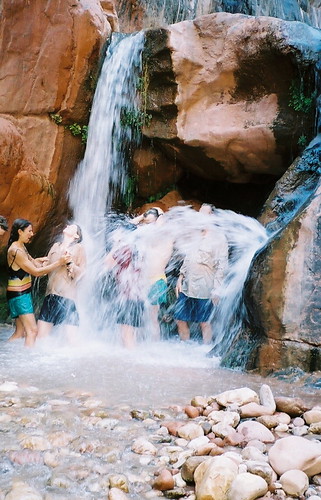
Well, Scrivener thought the last waterfall quiz was too easy, and Rob said I needed to stand blurrilier. So here's another waterfall photo, this one with five people and two waterfalls. Notice that the waterfall on the right is almost horizontal, water shooting straight out at us with all kinds of energy. Isn't that cool?
Now guess which person is me.
August 31, 2005
Reflection
In the summer, I try to cut myself off from the world of politics, from newspapers and television, from events happening outside my home. It's a well-needed break for someone like me who tends to react with emotion to all the tragedy in the world. Summer, I've always thought, is a necessary time for rest and relaxation and rejuvenation. Time to connect with the landscape, time for reflection.
Fourteen days in the canyon gave me a chance to forget about all that was happening in the world: the war in Iraq, the Bush administration's continued assault on the environment, and the endless ways in which sexism, racism, and homophobia continue to dominate the culture we live in. Well, maybe I didn't completely forget about these things, but it was wonderful to spend days just hiking, rafting, and absorbing all the beauty around me. Isolated as we were, we had no way of knowing what was going on in the country or the world, no way of seeing beyond the breath-takingly beautiful landscape we were travelling through. For two weeks, I lived in a community of fifteen like-minded people, many of us wanting a break from the politics that make us angry.
It is difficult now to read about the devastation in New Orleans, to surf blogs and read about what is going on in the country. One of my favorite students from last semester, who was commissioned the day after graduation, has been training all summer and gets shipped to Iraq this week. Tonight I watched television again, the local news, to see the story about a local boy, a young man who went to high school with my niece, who was killed yesterday in Iraq. He was 23 years old. I am trying desperately to keep the peace of the canyon inside me as I listen.
Morning shower
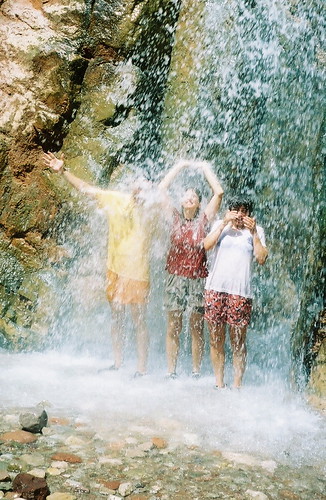
Before each hike in the hot dry Arizona air, I would lie down in the silty brown river to get my hair and clothes sopping wet. The icy cold water always felt great. Even so, after just a few minutes of hiking, I'd be hot and dry again. "This is just like hiking through a pizza oven," one of the other hikers commented.
Sometimes the canyons were dry and curving, with little stones that crunched under our feet. Non-fiction Writer sometimes brought his flute and would sit on a rock playing, the music echoing throughout the canyon. But often in a side canyon, we were following a creek and the sound of rushing water. I've lost track of how many beautiful waterfalls we saw. I don't have photos of many of them because I found it was hard to bring a camera on hikes that required me to swim through pools and scramble up rocks that looked like water slides.
I love the language of a waterfall, all that churning and tumbling, but on this trip I especially grew to appreciate what it feels like to plunge my hot tired body into all that tumbling clear water.
Note: I'm in this photo. Can anyone guess which one I am?
August 30, 2005
Sleeping in the canyon
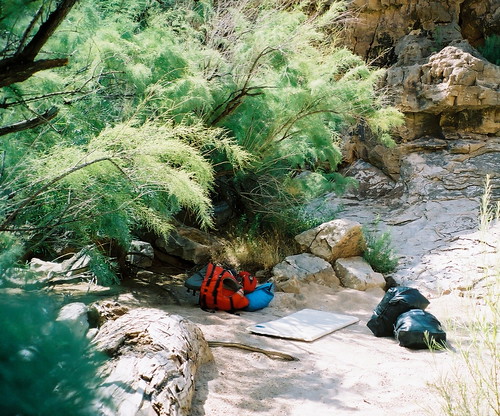
Day after day, we travelled on a river that flowed between steep canyon walls, the rafts rushing past rock over a billion years old. Near bends in the river, the churning water deposits huge piles of silt, forming beaches that make great camping spots.
Late afternoon, we'd pull into a beach, often looking to tamarisk or mesquite or the canyon walls for shade. The boatmen would begin unstrapping the dry bags, and we'd get in a line to pass the black rubber bags from person to person, piling them up on the shore.
After the first few nights, I realized that a tent was superfluous in a climate where it rarely rained, on beaches where mosquitoes did not seem to exist. Setting up camp meant tossing my white sleeping pad onto the sand and dumping my bags next to it. One of the black bags in this photo holds my sleeping bag, and the other holds everything else: clothes, journal, hiking boots. The orange life jacket became the most important part of my gear, its value more apparent with each rapid we went through. I was careful to clip it to the raft whenever I got off, and I used it as a pillow at night.
We did have a few thunderstorms. One night I woke to the sound of rattling tent poles as people around me rushed around to put up their tents. I pulled the small tarp out of my dry bag, spread it over me, and listened to the amazing sound of thunder echoing in the canyon. The day time thunder storms were spectacular: the clouds moving fast over the canyon walls, the misty look of rain moving toward us as we rafted, and the waterfalls that would sometimes appear on the cliffs.
I loved sleeping outside, waking to look at the stars, or the moon, or streaks of lightning above black cliffs. Just a few nights ago, I woke to the feel of fur brushing past my face. A ringtail cat, I thought eagerly. I sat up quickly, straining my near-sighted eyes to see the creature. Moonlight was shining from the right, and I could see dark ledges to my left. But the cat came back to rub against me, and suddenly the scene came into focus. The ledges were bookshelves, high on my bedroom wall, and the moon shone in my bedroom window. How strange to wake up and realize that I was no longer in the canyon but home in my own bed.
August 29, 2005
Drinking prickly pear juice
Of all the plants we saw during our hikes, the prickly pear cactus was one of my favorites. Often, the cacti were covered with bright-coloured fruit, which Storyteller Boatman picked and made into prickly pear margaritas. The juice was a beautiful bright colour, although a bit bland in taste.
The colorful margaritas added a touch of class to our nightly gatherings. Every evening, our small group would gather on the beach, to tell stories or read poetry. Sitting on the sand, we would examine our legs and feet for new bruises, new blisters, and the dreaded trench foot fungus. Non-fiction Writer would read dramatic excerpts from one of his books. We listened eagerly.
Sometimes Storyteller Boatman would tell funny boatman stories or play his guitar. A natural storyteller, he has done this trip almost 200 times over the last 20 years, so he had no end of great stories to tell. Before each of the big rapids, he would tell stories about famous people who had died in the rapid, heightening the anticipation of all that churning water. The poems he recited tended to be kind of macho – women and horses seemed to be a common theme -- so I responded one night with a feminist poem, just to give the gathering some balance. As it grew dark, we would all gradually stretch out on the sand, and Storyteller Boatman would point out constellations in the night sky.
August 28, 2005
Hiking the side canyons
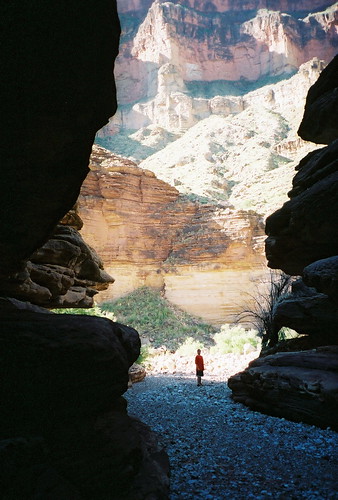
Several times each day, we would stop to hike up a side canyon. What is amazing is that each side canyon was different. Some were huge, big enough to hold whole fields of prickly pear cacti. Others were so narrow that we had to scramble up the rocks in single file. All were intimidating in terms of depth, making us humans feel very small and humble.
Often we were following streams of clear, rushing water. And we would be rewarded by waterfalls that we could climb up or big pools of water to swim in. The hot dry air of Arizona made me willing to plunge into water at any opportunity I could. One side canyon had a waterfall that flowed down over curving red rocks. You could climb into a cave, make your way up some boulders back behind the rushing water, come out onto a ledge halfway up the waterfall, and then leap into the pool below.
Subscribe to:
Posts (Atom)