December 10, 2006

Winter walk

stillness

Despite the busyness of the weekend, I sneaked out early yesterday morning to take a walk with my parents at Pretty Colour Lakes. I haven't been able to walk in my own woods for the last couple of weeks because it's been hunting season. The sound of gunshot makes me hesitate to wander far from my house. I wear a bright red coat, and I know enough to sing or make noise in the woods during hunting season, but I just don't find it peaceful to share the woods with men carrying guns. I could post the land and keep the hunters out, but I don't feel right about that either, since some of my neighbors have hunted here since childhood. Who am I to tell them they can't?

Hunting season ends today, and I am happy about that. Winters are long here, and I know from experience that I need to spend at least an hour each day outside, or I'll be miserable. Whether I am doing something exciting like snowboarding or relaxing like hiking around in my own woods or mundane like shoveling the driveway, just being outside breathing in the cold fresh air puts me in a better mood. When I was a baby, my mother says she used to bundle all of us kids up and take us outside for an hour, no matter how low the temperature dropped; that was part of her recipe for keeping us healthy and making sure we slept well. She and my father, both in their seventies and in very good health, still stick to that formula.

Yesterday, we hiked the trail around Pretty Colour Lake. How different it looked. All summer, the park is filled with green, green, green – leaves that ripple yellow green, green needles that give off scent in the heat, lake water that reflects green blue, bushes and ferns and green that edge the paths, green lawns where teenagers play frisbee. And in October, the park bursts with overwhelming colour: brilliant red and orange maple trees, whole trees saturated with colour, bright yellow leaves and that bright blue sky. Even in November, the more muted colours of autumn, the yellows and browns and darker reds, cover the ground in the form of fallen leaves, and green mosses appear everywhere, glowing.

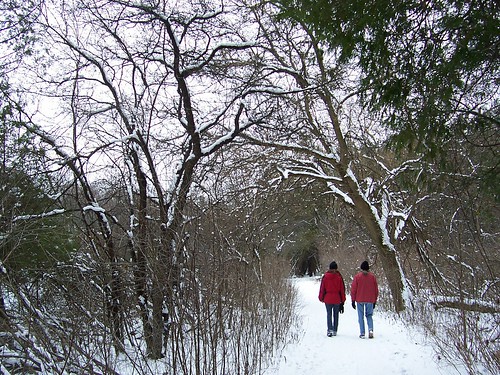
But a few inches of snow and icy weather transforms the landscape. In December, all colour drains from the landscape. Even the sky was white, and the water of the lake a dark grey. Except for the dark greens of the cedar trees, we walked through a 1930s black and white movie. It was a monochrome landscape, with white snow outlining curves branches and trunks and the bare roots of dead trees. Of course, the summer crowds disappear with the warm weather, and we were the only people in the park. Later in the winter, a handful of people will come here to cross-country ski or snowshoe, but yesterday, we had the woods to ourselves. When I handed my camera to my father, he snapped a shot of my mother and me walking down the trail, our bright coats the only bits of colour in the winter landscape.

Mom and me

December 09, 2006

Pause

December is the month for parties, for gatherings of friends and families. Weekends are suddenly busy. Those of us who have children in college are looking forward to having them home for a month. My own two college kids are here this weekend so that we can go as a family to cut down a Christmas tree. The weather has cooperated; a snowstorm dumped about six inches of snow across the landscape yesterday. The glittering white world outside the sliding glass doors makes our firelit living room that much cozier.

Today, I am busy looking for a Santa hat for With-a-Why to wear to his Christmas piano recital this afternoon and trying to decide what tacky item from the house to bring to a party tonight that includes a "recycled gift" exchange. In theory, I should be also baking something delicious to bring to the party, but I predict we will instead be dashing to the grocery store on our way to grab something already-made. Spouse is writing out a list of chores for the kids to do, including moving the living room furniture around to make room for the Christmas tree we will be getting tomorrow. I am making my usual pronouncements about how the house has to be clean before we bring in a tree. Everyone is ignoring me.

In the midst of this busyness, I am thinking of a conversation I had this week with Kindergarten Friend. We were doing our usual recap of what was going on with family members and friends. My brother is engaged to a woman that Kindergarten Friend has known since childhood, and I told her she'd be seeing them at our party this year. For more than twenty years, my husband and I have thrown a party on the Saturday before Christmas Eve: this year, because it's so close to Christmas, everyone in my extended family will be there.

The holiday season, with its annual gatherings and traditions that never change, can be both a comforting reminder of the stability in our lives and a marker of loss. Kindergarten Friend and I reminisced about the times in childhood that I used to help decorate her family's Christmas tree. Her father died four years ago, but I can still clearly remember his comments thirty-five years ago about the Christmas tree we were decorating; we both laughed at the memory. Her father liked a tree that looked perfect, the decorations all evenly spaced out. I used to say that they were the only family I knew who get a live Christmas tree and shape it and decorate it so carefully that it looked artificial.

It is still hard to believe that Kindergarten Friend and I are both grown up. I have a daughter who will be spending spring semester in London; even some of my kids are adults now! Kindergarten Friend's kids are both still young, but she has a nephew who is about the same age as my daughter. He is in the air force.

"We won't be seeing him over the holidays," she said.

She paused. I said nothing, because I knew what would come next. Every holiday season now, some of the young people in our community are absent.

"He was shipped to Iraq last Friday."

December 07, 2006

Dance

It was a celebration, an evening of singing and drumming and dancing, an evening of community and thanksgiving.

We gathered in a big gym near campus, with a polished wood floor and bleachers to sit on. Long tables held food and water, and people piled their winter coats near the walls. A group of local native women, men, and children led the dancing, with one older native woman explaining the dances and inviting everyone to join in. The singing was chant-like, with enough repetition that those of who did not know the language could sometimes join in. Each dance had a name and some specific elements, but every dance meant moving in a circle around the gym, with white people like me trying to learn the steps by watching and following the leaders.

The native dancers who were hosting this celebration chose to wear their traditional clothing. Four of the boys wore headdresses, with feathers that reveal by their arrangement which nation the boy belongs to. All the dancers wore shirts of pretty colors, with long strings that hung down and swayed back and forth, shirts with fancy beadwork and designs. The men wore breech cloths, the women skirts, and all wore leggings underneath and moccasins on their feet. All three layers were made of fabric, and Older Woman With Microphone explained that native people in this area have been using fabric for about 400 years. The colorful layered outfits and soft moccasins looked like they would be comfortable for hours of dancing, and I could not help but compare this to dances at corporate holiday parties in my own culture, dances in which women wear crippling footwear like stiletto heels, where you see women sitting at the edge of the dance floor with their high heels in their hands, resting their poor sore feet.

Older Woman explained to us that these dances were social dances, not ceremonial dances. The ceremonial dances are not done in public. One dance was for women only, and we moved in a circle, twisting our bodies back and forth so that our feet slid across the floor, the soles of our feet never losing contact with the earth. Other dances included moving along with a partner, the line turning back on itself so that we had to dance through two lines of people who stretched their hands out towards us, a dance that reminded me of the Virginia Reel and the childhood game London Bridge is Falling Down.

Always, we all kept our eyes on the native dancers in the circle, trying to follow their movements, until we were all moving in a shuffling, stomping circle, grandmothers and teenagers and children and professors and college students, people in jeans and suit jackets and holiday sweaters and t-shirts and blazers and flouncy blouses, all of us moving to the same rhythm, following the voices that sang in a language that most of us did not understand.

One boy about the age of Boy in Black, with the same long skinny body that my son has, performed a hoop dance, gradually picking up and dancing with eight hoops. We watched, applauding, as he spun and twirled, pulling his body through the hoops, balancing the hoops, holding them in patterns, dancing and moving so fast that we barely had time to see each pattern before he would shift to another one, his gorgeously coloured outfit moving and twirling with him, his hands and legs holding onto all eight hoops, all to the beat of the two drummers, father and son, who kept up the fast rhythm, the hypnotic music.

The evening ended with food and conversation, with drinks of water for our sweaty bodies, and of course, with words of thanks spoken solemnly by one of the older men in the native language of people in this area. Older Man explained that he had learned this language, ironically, as a second language because his mother, put in a boarding school, had been forbidden to speak the language, punished and shamed for the language of her people. His people are still working to preserve this language, make sure that it continues. He spoke into the microphone, and the words filled the room, words that I understand now because I've read the translation so many times, the words of thanksgiving.

December 06, 2006

The white cloth

White cloth

I know that some of you are looking at that photo and saying, "Why is jo(e) posting a photo of a cat on a Wednesday? Doesn't she know that Friday is cat blogging day?"

Of course, others of you are shocked to see a cat on the kitchen counter. You are thinking – how unsanitary, I am never eating at jo(e)'s house. But let me reassure you. Come to my house and there's a good chance that you will be eating delivery pizza out of a cardboard box. The habits of my cats will not be a factor.

And to get back to that original question, this isn't a photo of a cat. Look closer. It's a photo of a white cloth.

The white cloth is the answer to a question that several readers asked me a few posts ago. I had casually mentioned that I don't buy paper towels, that I don't like using disposable products, and other parents emailed me to ask, "What do you use to mop up spills? With all those kids, you must use something! Don't your kids spill stuff?"

In fact, spills happen all the time in our house. I think teenagers are worse than toddlers when it comes to spills. First of all, no self-respecting teenager will use one of those little tiny sippy cups. No. A teenager will pour a huge quantity of weird red juice, like maybe a gallon or so, into a tall glass (or a vase if every glass is dirty) and then leave the glass on the floor near the feet of some other teenager who is practicing a Jimi Hendrix move with an electric guitar. In our house, someone it always eating or drinking something, and when you combine scattered half-filled cups and bowls with bizarre ideas like, "Let's throw lit matches on the floor and see if we can blow them out before we burn holes in the carpet," well, spills happen.

When inevitably, the mug of hot cocoa gets knocked over by a kid standing on a chair to tack blankets over the window for an extra-dark game of Monster, someone yells, "Get some white cloths!" And one of the kids (usually an extra, not one of my own kids) will grab a handful of white cloths from under the sink, toss them on the spill, and jump up and down on them until all the liquid is absorbed. The white cloths then get thrown into a big plastic bucket that looks suspiciously like a diaper pail. When the pail is full, one of us (okay, usually my husband) dumps them in the washer with some detergent and bleach and washes a load of white cloths in exactly the same way you would wash a load of diapers.

Diapers are, of course, the origin of the white cloth habit. For about twelve years, our household had at least one kid in diapers so we always had plenty of diapers on hand. And a thick cotton diaper is maybe a thousand times more absorbent than a paper towel. Who would use a paper towel when you could use a diaper instead? And besides, as I've mentioned before, I don't like to buy disposable products.

When the kids were little, we washed diapers every other day, but then even after the last kid stopped wearing diapers, I saw no reason to get rid of the diaper pail. We went on using the diapers in all the ways you would use any kind of rag – to clean a sink, to mop up a spill, to wipe snot from the face of a toddler, to tuck into a kid's shirt as a bib, to toss on the floor when dripping wet teenagers come in from playing Ultimate Frisbee. When some of the diapers wore out completely, I replaced them with generic white cotton cloths sold at a wholesale club. We stopped calling them diapers, because white cloth just sounds so much classier.

When we go on car trips, we grab a stack to toss in the car with us so that everyone can put one on their lap when they are eating sandwiches that drip with salad dressing. When I carve a watermelon, I toss white cloths underneath the cutting board to absorb all the juice that runs off. When a kid comes in with an injury, I put ice cubes in a white cloth. When we bring in our icy snowboards and prop them in the hallway, we put white cloths underneath to absorb the melted snow. When I accidentally give a plant too much water, and water comes pouring out of the bottom of the pot, dripping down onto the carpet, I grab some white cloths. When the kid who is standing on the table to duct tape toys to the ceiling fan knocks a bowl of soup to the floor, I grab some white cloths.

I don't know how any household manages without them.

December 05, 2006

Hearth

with guitar

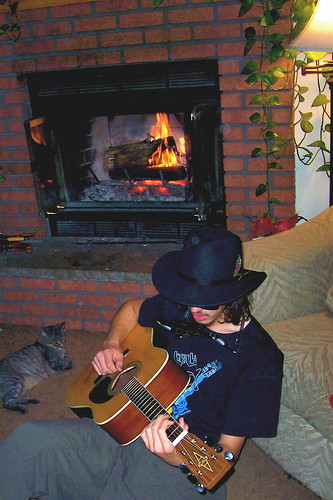
Twice a week, Boy in Black drives back to Train Track Village for a drum or guitar lesson. Usually, he'll stop home for a few hours. The afternoons here are dark and cold now that winter is coming, but the house seems cozy as I sit on the couch with my laptop. Shaggy Hair will work on his homework, while With-a-Why will focus intently on his drawings and ask me to make him soup. I usually build a fire as soon as I get home, and Boy in Black will get out his guitar and harmonica. It's a nice atmosphere: a fire in the fireplace, cats stretched out sleepily in the warmth, and some music from the boy who thinks he is the next Bob Dylan.

December 04, 2006

That tasty Christmas tree

Pets and Christmas trees have long been a dangerous combination. When I was a kid, I can remember watching one of our cats climb the just-cut spruce tree in our living room; I think she thought the tree had been placed there for her benefit. When you are a little kid, and not the person who has to mop up all the water, it's exciting to watch a cat climb to the top of tree that is swaying back and forth dangerously. It's possible that my parents did not find the toppling Christmas tree as entertaining as we kids did, because after that, my father began tying wires to the top of every Christmas tree and attaching the wires to curtain rods or screws in the wall. I had at least one high school friend who mocked the wires lashing the tree into position, which he said gave the impression we were preparing for a natural disaster rather than a holiday party. Our parties always had kind of a Poseidon Adventure theme going on.

Peripatetic Polar Bear reports that having a Christmas tree has helped her discern the religious leanings of her cats. I don't think I've ever been patient enough with pets to take note of their spiritual practices. (Is there any religion that encourages peeing in annoying places? If so, I've got a bunch of disciples here.) I do think Christmas trees can cause bizarre behavior among all kinds of creatures. We had this dog when I was growing up — a black lab, well, a mutt really, but he was partly black lab — whose only skill was barking at anything and everything. On television shows, wild barking always means a smart dog is alerting you to something terrible ("Timmy has fallen down the well again!"), but in real life, some dogs just bark all the time. Anyhow, this dog was so excited by the Christmas tree that he actually ate a glowing red light bulb. He chomped right down on it. Surprisingly, it did not hurt him the least, although it did short out a whole string of lights.

When I was about ten, I decided one year I was going to have my own little Christmas tree in the bedroom I shared with my baby sister. So on a hot day in August, I wandered the fields up at my parents' camp until I found a white pine seedling just the right size, which I dug up, put in a big pot, and lugged half a mile or so back to camp, where I kept it in the shade until I could pack it in the back of the car to come home with us. That fall, I kept the little tree in my room, on top of a chest of drawers, and watered it every week. At the beginning of December, I decorated the tree with a string of little lights and some little tiny ornaments. I can still remember how pretty it was.

After Christmas, I took all the little ornaments off the tree, but continued to care for it. In the spring, I decided it was time to plant my tree outdoors. I was so proud of having a tree that would keep on growing; even then, I had environmentalist leanings. I lugged the pot out to the backyard, setting it down near the horse paddock while I found a shovel and went to dig a hole in a spot that needed a pine tree. While I dug, I thought fondly of how someday I would point this tree out to my own children and tell them the story of how it had been my own little Christmas tree.

Once the hole was dug, I went back to get the tree — and it was gone! Our horse, an appaloosa that loved to eat, had put her head through the fence, grabbed the carefully nurtured little tree with her teeth, and eaten the whole thing in a couple of gulps.

December 03, 2006

Black Ice

In early December in Snowstorm Region, car accidents happen pretty often. The beginning of winter creates black ice on roads that haven't yet been heavily salted. You can't see black ice, especially at night. It happens to every driver sooner or later: you hit a patch of ice, and your car spins out of control. It's a frightening, helpless feeling because there is nothing you can do once the car starts spinning. It's scariest when you have passengers in the car and can do nothing to protect them.

It's been fifteen years, exactly fifteen years today, since the car accident that changed my life, but I can remember the details vividly. It began as a lovely winter night, full of anticipation. My sister-in-law was in labor, and we were driving to the hospital so she could give birth. She and my brother had not been married very long, but she had four kids from a previous marriage, and she had asked me to come along to be a support person for the four kids. We were all excited to watch the baby being born. It was late at night and just beginning to snow as we left their driveway in two vehicles, and we all thought that was a good omen: the first snow of the year is special snow.

Things were fine until we were on the highway. Then my brother, just ahead of me, hit a patch of black ice and his van went into the median, sliding to a stop in the snow. He and his wife, who was in active labor, got into my station wagon along with the four kids. We didn’t have enough seatbelts for everyone, but we crammed everyone in. We came to the next bridge, and then my car hit another patch of black ice. The car spun out of control and crashed into the guard rail.

It was a nightmare. My niece, sitting behind me, was screaming so loud that I thought her legs had been cut off. My sister-in-law, in the seat next to me, was silent. The horn kept blaring. I’d broken something in the steering column when my face smashed against the steering wheel. Cars zoomed by us as I gathered the children, pulling them away from the dangerous traffic, checking them to see if they were okay. My brother yanked my sister-in-law from the front seat, and a passing car took them on to the hospital.

When the ambulance arrived, I was angry at the driver because he barely glanced at the children, who were standing around me in a circle, and instead focused on me. He kept telling me that the only way he would transport me to the hospital would be if I let him strap me to a board. I kept trying to explain to him that I was supposed to be taking care of the children. "I’m fine," I kept saying, "I didn’t get hurt."

He put his hands to my face and then pulled them away. He held them out to show me that they were filled with blood.

It was a long night in the hospital, all of us huddled in the emergency room, the kids dazed but okay, me bleeding profusely all over everything, leaving bloodstains on the kids when I hugged them, and trailing drops of blood when I would make the trek up to the other floor where my sister-in-law was laboring, with packs of ice on her injuries. My right hand was broken but I didn't know it yet because I had refused X-rays, and I was still in some kind of shock that made everything seem unreal.

When morning came, my niece, Drama Niece, was born, healthy and beautiful.

The injuries healed over the next few months. Well, at least the physical ones did. The only physical reminder I have from that night is the throbbing I get in my right hand just before it rains. But that night somehow stirred up a stew of emotional issues for my sister-in-law and brother, leading to all kinds of crazy behavior: a lawsuit, angry words, and eight years of silence from both her and my brother. My right hand healed after six weeks in a cast; the emotional healing from the pain that began that night took considerable longer.

Every year, I dread this anniversary. It's a scab that gets ripped off, smaller each year but still present. I have to remind myself that the car accident is in the past: the children with me that night have grown to adulthood, the lawsuit settled out of court because they had no case, my sister-in-law died of breast cancer a few years ago, and my brother, after his wife's funeral, began speaking to the family again.

Over the last year, I've come to see the role thanksgiving plays in healing. As some of my readers know, I have been participating in a year-long dialogue between native and white people in this area. During the year of discussions, lectures, performances, and talking circles, one of the things that has impressed me the most is the way that the native elders, the People of the Longhouse, have kept stressing this need for thanksgiving. The words that come before all else.

So this year on this anniversary, I am going to try to be thankful. Not for the car accident that happened fifteen years ago, but for all the people in my life who helped me deal with everything that happened after that. That painful period of my life led to all kinds of awareness and realizations: I learned to take better care of myself, I began dealing with emotional issues I had avoided, I began to understand the need to confide in close friends. I began writing poetry as a way to heal. I learned reiki. I grew up.

Yes, it still seems unfair that I hit black ice that night. I don't believe in the stupid cliche that "things happen for a reason." I think sometimes weather patterns leave black ice on the highway, and the average station wagon is not designed to deal with it.

But growth and richness can come from painful situations, and I have come to think that one role pain can play in our lives is to emphasize the ways in which humans need each other. I have shared the painful details of that period with close friends, and my pain has deepened those friendships. The car accident was a catalyst that led to growth, to healing. I am thankful for patient friends and a supportive husband who helped me deal with the emotional chaos that began on a dark highway fifteen years ago.
December 01, 2006

Favorite Toys Meme

These were my favorite toys when I was a kid.

1. Raggedy Ann and Andy dolls. I loved these dolls dearly. They slept with me every night and came with me when I went to college.

2. Red plastic toboggans. In my childhood, I think they had just been invented. They were so much faster than the old sleds with metal runners. They've been replaced, for the most part, with the inflatable tubes that you see on hills nowadays, but some loyalists still hold out for the plastic toboggan.

3. Wooden blocks. No household with young children is complete without wooden blocks. I can spend hours playing with wooden blocks. You can tell a lot about a person by handing her a box of wooden blocks and seeing what she builds.

4. Train tracks and trains. I know these are still around because I've read about them on blogs, although for some mysterious reason the trains now have people names. In my day, trains did not have names. They were just the "yellow train" or the "red train" or "that's the train I always use and don't you dare take it." The train tracks of my childhood were grey plastic ones, but by the time I had my own kids, wooden train tracks had become popular. We live near the Famous Timber Company that makes wooden train tracks and trains, and I used to buy them wholesale (you could fill a bag with tracks and buy them by the pound) so we have a huge train track collection. I fully intend to play trains with my grandchildren.

5. The game that you put together so that marbles run down ramps. I don't know what it was called but it was so much fun to watch the marbles zoom around.

6. Trucks, the kind that can move and dig dirt. When I was a kid, the trucks were metal and could dig far more effectively than the safe plastic ones you see today. My parents had an entire truckload of sand dumped into our back yard so we had the biggest sandpile of any kid I knew. My brother and I spent long summer mornings playing trucks. Our truck driver names were Jo and Joe.

7. Spirograph. I loved the colored pens, the cool designs.

8. Candy Land, Chutes and Ladders. We played board games all the time when I was a kid. The excitement of picking up a card and seeing that you had just gotten the ice cream float! I loved these games because they required no skill. I still like that kind of game. It's the only way I can win anything.

9. Jigsaw puzzles. My mother would set up a card table against the picture window, and we would spend a winter afternoon putting the puzzle together. I would look up to watch the snow coming down and hope for a snow day so that we could stay home and work on the puzzle the next day.

10. Modeling clay. I was pretty old before I knew that clay came in different colors. The clay we had was lumpy and brown-grey, and we kept it in an old coffee can. But we would spend whole afternoons sitting at the kitchen table making things. Snakes were my specialty. I was never really good at anything else. But I loved it just the same.

November 30, 2006

You better watch out

Late Thursday afternoons, it's dark as I drive With-a-Why home from his piano lesson, and today we noticed that some homes had Christmas lights already. Ironically, the warmer the weather is at Thanksgiving, the more likely people are to put up lights. It's understandable that people are more willing to get out the ladders and staple guns when they don't have to trudge through snowdrifts and fight icy winds, but to me, Christmas lights look strange and out of place when there is no snow. Oh, we are sure to get some snow eventually, but right now we are having an unusual warm spell and the houses that still have their Halloween decorations up look more in keeping with the season.

As we turned onto one street, With-a-Why gasped in horror and said, "Look!"

The houses on the street were mostly dark, since most people were still at work. A strong wind was blowing dead leaves across the lawns and shaking the mailboxes. In almost every front yard stood a huge inflatable Santa. Not just life-size, larger than life. These huge floating Santas appeared to be tethered in some way as they bobbed in the wind, looming over anything human-sized. White beards and weird smiles glowed in the dark, high above our car. Maybe if the figures were nestled into snowbanks, they would seem cheery and Christmassy but that was not the effect here at all. This was creepy. It was if some kind of evil Santa had cloned himself and was poised to take over the world.

And it got worse. At the edge of one house, glowing white and even creepier, shining in the streetlight, was a gigantic snowman with an evil grin, bobbing up in the cold November wind, high above mailboxes and trash cans. Remember the scene in the Ghostbusters movie in which the Stay-Puff Marshmallow Man was threatening to destroy the city? Exactly. like. that.

I just know this is going to give me nightmares.

November 29, 2006

My Christmas tree philosophy

I've always argued that a Christmas tree is supposed to look like a Christmas tree; that is, a tree decorated by all sorts of family members, including little kids who hang ornaments in the strangest places, and kittens who knock stuff off so that you have red balls rolling around in the manger scene. A Christmas tree is supposed to be lopsided because that's how you know it's a real tree. I mean, why would anyone want to buy a tree that looks artificial? And a Christmas tree is supposed to be covered with a strange assortment of decorations that don't match each other because they've been given to you by all different people, each ornament with a story and a history to go with it. The best parts of any tree is the homemade stuff: my parents' tree still holds tacky deocrations that I made in elementary school as well as ornaments made by their grandchildren. You can tell a lot about a family by looking closely at what hangs on the Christmas tree.

I have never understood friends who want try to coordinate the ornaments of their tree or who want their tree to look good. Oh, I still talk to these friends, and even go to holiday parties at their houses, but I don't understand them. At all. I mean, if what you want is an aesthetically pleasing tree, if beauty is what you are after, than I recommend that you leave that tree out in the farmer's field where you got it in the first place. No amount of tinsel or artificial lights can possible come close to the way a snow-covered tree looks on a sunny afternoon in December, with ice crystals shining from the green needles, with acres of trees and a whole golden-white pasture stretched out behind it.

To me, Christmas trees are like snow forts or sand castles or art projects: the fun part, the worthwhile part, the creative part, is the process of getting the tree and decorating it. The finished product is not what matters.

Some of my most treasured childhood holiday memories are from the exciting day in December when we would finally go get our Christmas tree. We'd get dressed in our winter clothes, with boots and hats and mittens, cram in to the station wagon, and drive out to an old farm, where we'd spend an hour or so tramping around in the fields, looking for just the right tree. We'd argue about which tree looked the best, and we'd knock the snow off the branches to see how thick the branches were, and my father would always stand next to the tree with his arm up, saying, "Look, gang, this is where the ceiling is."

My father would cut a tree down, and we'd have the excitement of carrying the tree, all of us helping, across the snowbanks. We'd stand in the barn, drinking hot chocolate and getting warm, before piling into the back of the station wagon, us kids clinging to the tree so that it wouldn't fall out. Seat belts hadn't been invented yet, and it was an exciting ride home, hanging onto those prickly branches, breathing in that spruce smell, and wondering if we were all going to go flying out the back of the car.

We always ended up with a tree way too big – because a tree that looks small out in the field suddenly become much bigger in a living room – and my father would cut off the top to make it fit, and so our trees never had that kind of shape you see in Christmas cards. We often ended up with a tree that would list to one side, as if it had been drinking too much eggnog, but my father would solve the problem by tying wires to the top and attaching them to curtain rods. Perhaps the best part is how great the whole house always smelled, that pine scent of the woods filling up the rooms. The tree stood in the corner of the living room, and my brother and I would crawl back behind the tree, where the thick green branches made a secret hiding spot.

Supper was always homemade chili over rice, and afterwards we would decorate the tree. My father would put on some Christmas music. My mother would open the big cardboard box of ornaments and pass them to us kids. She would stop and talk about her favorite ornaments sometimes, or tell stories from her own childhood. We'd stand on kitchen chairs to reach the top of the tree, and I always insisted on hanging some ornaments in the back of the tree, even though no one could see them. There was often some kind of big argument about whether or not to put on tinsel, but my mother loved tinsel and her side always won. The room was dimly lit by the glow of the big, colored Christmas tree lights that made the ornaments and tinsel shimmer.

It took all weekend really, getting the tree, decorating it, setting up the village under the tree, putting out the manger scene, and then finally, taking time to admire our work. My father would say, "Look at it from this angle!" and he'd lay down on the floor under the tree. And we'd all lay down, bumping our heads under the tree. That is still one of my favorite ways to look a Christmas tree, staring up at the swaying tinsel as it moves and catches the light.