In my classroom we often analyze language, and the ways such things as gender stereotypes – or the myth of male superiority – are enforced by words and phrases. For instance, the other day, a student said that her friend's father had referred to her as a coed. She felt uncomfortable because he said it in a mocking way, but she didn't know why it was an insult.
The word coed was coined when colleges first began admitting women. The norm was that college students were male. So the word college student meant a male, and so female students were coeds. The term is still used today, often as an insult, as a reminder that colleges were founded to educate men, and that women were admitted later and perhaps shouldn't really be there. Calling a woman a coed is one way to adhere to an outdated and sexist norm. A few of my students, young as they are, acted surprised that there was a time in history when women barred from most colleges. "Ask your grandparents," I told them. "It wasn't that long ago."
One of my male students volunteered that he had seen the word coed used in a porn magazine, which often features such things as "Coed of the Month." He said, "I guess I thought the word coed meant sexy college chick." It did not surprise me to hear that porn magazines present female college students as sex objects. It makes good patriarchal sense to suggest that the reason for colleges admitting women was merely to serve the sexual needs of the male students.
One of my colleagues told me a story recently about taking her daughter to the dentist over the summer. The dentist asked the daughter the usually kind of trivial making-conversation questions, and when she said that she was in college, a prestigious college that he had surely heard of, he asked, "Going for your MRS?"
Colleague's daughter looked at him blankly. She had no idea what he was talking about.
"I'm getting a degree in marine biology," she said.
Young women in college are still being subjected to this cultural assumption: a woman goes to a prestigious college in order to find a rich husband, and not because she is intelligent or eager to learn or planning a career.
I get angry just thinking about it.
September 30, 2006


September 28, 2006
The Devil Wears Satin
I've been grading papers all day, an activity which sucks all the vital energy out of me, leaving me in zombie state, unable to even read, which ironically is the very activity I need to be doing. By this time of the semester, I know the students pretty well, and I have the bad habit of pulling out the papers that I know are going to be well-written and interesting – the kind of essays I love to read – and grading them first. That leaves me to slog through the unfocused essays when I am tired. Yes, it's a bad strategy, I know.
Late this afternoon, I read an introduction that included a line about the evils of satin, and I thought to myself, "Well, that's interesting." I didn't know the fabric was controversial. Maybe he was going to talk about sweatshops or classicism or the pressure for women to conform to gender roles. All kinds of interesting possibilities raced through my mind.
It wasn't until I reached the second paragraph and he started talking about God and nature that I realized who Satin was. Not the fabric. Not even a cool superpower or a comic book character.
I admit that I was a little disappointed.
Late this afternoon, I read an introduction that included a line about the evils of satin, and I thought to myself, "Well, that's interesting." I didn't know the fabric was controversial. Maybe he was going to talk about sweatshops or classicism or the pressure for women to conform to gender roles. All kinds of interesting possibilities raced through my mind.
It wasn't until I reached the second paragraph and he started talking about God and nature that I realized who Satin was. Not the fabric. Not even a cool superpower or a comic book character.
I admit that I was a little disappointed.
September 27, 2006
Delicate wings
When I was a little kid, I would sometimes sit on the lawn on a lazy summer afternoon, making chains out of dandelions or looking for four-leaf clovers. And from that low vantage point, I would notice butterflies, skimming just above the grasses. My mother had warned me not to try to catch a butterfly – she said that my fingers would damage the wings – so I always just watched carefully until the butterfly was out of my sight.
As I grew older and taller, I stopped noticing butterflies. I think I was always moving too fast, or looking at bigger elements of the landscape. Until I met Artist Friend. When I take a walk with him, he always points out things that I wouldn't notice – an unusual fern, perhaps. And often, he points to butterflies. "Nice swallowtail," he'll say. And he'll pause to watch where the butterfly goes, his whole attention focused on those delicate wings.
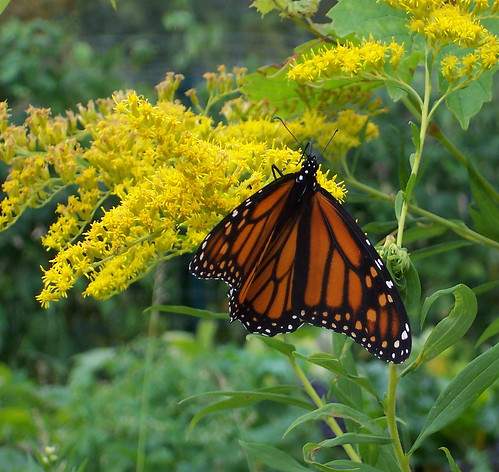
Last weekend, while I was walking through the orchard at the monastery, I noticed a beautiful monarch butterfly flitting around the banks of wildflowers. I sat on the grass for a while and watched the butterfly, thinking about Artist Friend and taking the time to sort through all kings of things in my life. I took a photo for my blog friends because I figured I might have deep and profound things to say about this butterfly. After all, the butterfly figures prominently in the mythology of many cultures, sometimes as the messenger between heaven and earth, sometimes as the symbol of rebirth and regeneration. It seemed that the presence of this butterfly, which danced and flew and kept folding and unfolding its wings, might have some deep spiritual significance.
So I planned to write a post about butterflies today. I woke up at 6:30 am to spend time with my two youngest as they got ready for school. Then I hurried to campus, taught my first class, answered a bunch of emails, graded maybe one paper, talked to a colleague who needed advice, taught my second class, talked to a student, wrote several emails, ate half a bagel, taught my third class, met with an advisee, talked to another colleague, went to a long but productive meeting with an administrator, graded a few papers, ate the other half of my bagel, wrote an abstract, met with my 5 pm seminar class, raced home in time to join my husband for Meet-the-Teacher Night at Shaggy Hair's school, talked to Boy in Black, who had stopped home after his Wednesday drum lesson, read to my youngest child, helped my husband put away the groceries he had run out to get after we realized we had no bread for school lunches ... and then sat down after 10 pm to finally eat something substantial and write a profound post about the butterfly at the monastery.
But really, the only profound thought going through my head is this: I can't believe that just a few days ago I had time to sit quietly in an orchard and do nothing but watch a butterfly.
September 26, 2006
Photo from the monastery
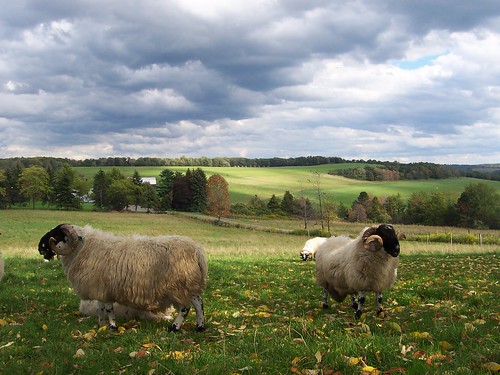
If you look carefully at this photo, you can see just the tiniest bit of blue sky, like a piece of a jigsaw puzzle taken from another landscape.
Sometimes just a tiny bit of blue sky is all we get.
September 25, 2006
Walking the fenceline
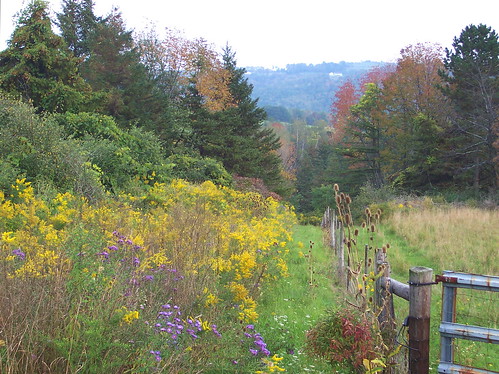
When I visit the monastery in March, the farm is usually still buried in snow, with drifts of white spread across the fields, and a ripple of gold from the curving banks of dried grasses. And all summer, the sheep pastures are green, dotted with the fluffy white bodies of the sheep.
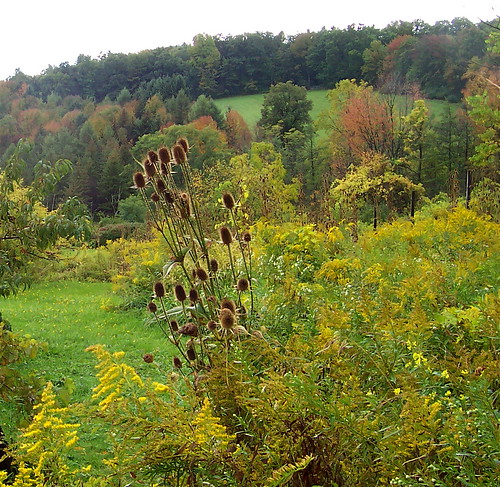
But September is early fall, and autumn colours are beginning to creep into the leaves of the maple trees. The wildflowers that grow in big untidy banks are yellow and purple. The sheep pastures are still green, and the grape arbor covered with green leaves, but that green serves only to make the bright yellow of the goldenrod that much more vivid.
I spent much of my time at the monastery wandering through sheep pastures, hiking along the fence lines, or just meandering about the apple orchard. I had no goal in mind, and no plan, just the idea that somehow I needed to absorb as much of this beauty as I could before winter gets here. And I was rewarded by all sorts of surprises – a lush display of wildflowers, a tree full of deep red apples, a persistent butterfly, and sheep that entertained me with all sort of antics.
I suppose my thoughts and prayers followed a similar meandering route. When I am on retreat, I leave behind all the day-to-day thinking that fills up my head, and I allow other thoughts and feelings to rise to the surface. As I walk along the sheep pasture fence, alone, I am often surprised at which path my own thoughts take. Just as leaves burst into bright red colour before they crumple and fall to the ground, long hidden emotions surface with a final bright flash before I can sort them and figure out where they belong.
The monastery is a safe place for that kind of sorting. After an afternoon of wandering through yellow and purple and green, I spent hours talking to Monking Friend and Nurse Friend, the three of us gathered in the comfy chairs in the old stone farmhouse, all of us relaxed after a quiet day of reflection, the three of us intent on putting our lives into balance.
September 21, 2006
Gone monking
The first month of fall semester was busy and exhausting, both physically and emotionally. My two oldest kids went off to college, my two youngest went back to school. I have spent all kinds of time with my 60 first year students, helping get them adjusted to college life. My husband and I have had to deal with his mother's transitional issues as she gets used to living in an assisted living home. I've already read 480 pages of student writing. And after 35 years of trying to correct my horribly near-sighted eyes, I've been struggling with contact lenses and glasses to correct the newest problem: I am now far-sighted as well. (Yeah, I have said how getting old would be cool, because I want to be one of those old women with all kinds of wisdom, but I am not so much in favor of the body falling apart. I suspect my deteriorating vision is just the beginning. Sigh.)
I feel ready for a retreat.
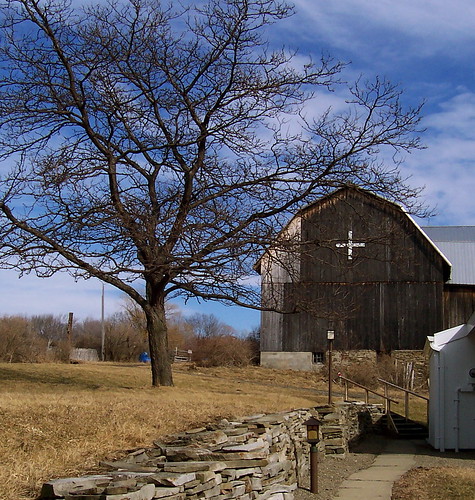
I'll be spending the next four days at a Benedictine monastery, a place that includes a working sheep farm, an octagonal chapel, and several guesthouses. The monastery, located high in the hills above a sleepy river, overlooks farm pastures and woods. The monks gather in the chapel seven times each day for prayer, but in between the services, they discard their dark robes to drive tractors, feed sheep, make beeswax candles, and pick apples.
Longtime readers know that the monastery is a place I return to, again and again, as a way to keep my life in balance. I'll be staying in an old stone farmhouse with two close friends, Monking Friend and Nurse Friend. We will talk on the drive there, catching up on each other's lives. At every meal in the guesthouse, we will talk about books and movies, about our children and our marriages, about our failings and our goals for ourselves.
But we will also have time, each of us, to be alone.
I'll walk through the sheep barns, breathing in the smell of hay and manure, and I'll spend hours sitting in the sun at the edge of the sheep pasture, watching the sheep trot along in single file like school kids. I'll take a nap in the afternoon, with no kids to interrupt my sleep. I'll lie on the grass in front of the chapel and read a book. I'll walk down the stone steps into the crypt to light a candle in front of a centuries-old stature and sit cross-legged on the stone floor, staring into flame.
Of course, I am an extrovert so I'll also seek out my monk friends. I'll go hiking with Brother Beekeeper, to hear what's been happening in his life. I'll wander into the candle-making workroom to hang out with Brother Joking, who is sure to tease me about the time I went skinny dipping in the river or the time that Monking Friend and I backed into a lamp post, knocking it down. At meal times, my friends and I will chat with the other guests, enjoying that intimacy that happens so quickly when women on retreat gather around the table.
I will return next week with beeswax candles, monastery cider, and stories to tell.
I feel ready for a retreat.
I'll be spending the next four days at a Benedictine monastery, a place that includes a working sheep farm, an octagonal chapel, and several guesthouses. The monastery, located high in the hills above a sleepy river, overlooks farm pastures and woods. The monks gather in the chapel seven times each day for prayer, but in between the services, they discard their dark robes to drive tractors, feed sheep, make beeswax candles, and pick apples.
Longtime readers know that the monastery is a place I return to, again and again, as a way to keep my life in balance. I'll be staying in an old stone farmhouse with two close friends, Monking Friend and Nurse Friend. We will talk on the drive there, catching up on each other's lives. At every meal in the guesthouse, we will talk about books and movies, about our children and our marriages, about our failings and our goals for ourselves.
But we will also have time, each of us, to be alone.
I'll walk through the sheep barns, breathing in the smell of hay and manure, and I'll spend hours sitting in the sun at the edge of the sheep pasture, watching the sheep trot along in single file like school kids. I'll take a nap in the afternoon, with no kids to interrupt my sleep. I'll lie on the grass in front of the chapel and read a book. I'll walk down the stone steps into the crypt to light a candle in front of a centuries-old stature and sit cross-legged on the stone floor, staring into flame.
Of course, I am an extrovert so I'll also seek out my monk friends. I'll go hiking with Brother Beekeeper, to hear what's been happening in his life. I'll wander into the candle-making workroom to hang out with Brother Joking, who is sure to tease me about the time I went skinny dipping in the river or the time that Monking Friend and I backed into a lamp post, knocking it down. At meal times, my friends and I will chat with the other guests, enjoying that intimacy that happens so quickly when women on retreat gather around the table.
I will return next week with beeswax candles, monastery cider, and stories to tell.
September 20, 2006
Walking through oil paint
Faced with a houseful of dirty dishes, a pile of wet logs that needed to be stacked, a miserable sort of headache, and a desk covered with folders of important stuff that had to be done immediately, I decided yesterday to do the only logical thing: I put down the to-do list and went with a close friend for a walk at Pretty Colour Lakes. These glacial lakes, part of a state park just a few miles from my house, were formed more than ten thousand years ago, two deep plunge pools carved into the limestone bedrock by waterfalls rushing from a melting glacier.
No matter how miserable my mood, I always feel better as soon as my sneakers touch the mulch trails of Pretty Colour Lake. The autumn smell of yellow leaves mixed with the scent of the cedar trees as Quilt Artist and I started around the lake. Some of the white cedar trees that edge the lake are more than a century old. They were here when my Dad came to the lake as a child. High in the hills just above the lake are remnants of old growth forest.
I've walked the trails at this lake hundreds, no, thousands of times. My earliest memories include family picnics with my parents and Picnic Family, the six of us children collecting bright red leaves and scrambling up the steep hills around the lake. I came to the lake as a teenager to swim, or to camp with Outdoor Girl and her family, or to take quiet walks with a boyfriend. When my own children were small, I usually nursed a baby in a sling as we walked. I come to the lake often in the evening with my husband, when we can sneak an hour or two to ourselves. I bring my out-of-town friends to this lake: I walked this trail with Artist Friend a few years ago, as a way to weave the landscape of cedar trees and green water into our friendship.
Pretty Colour Lakes are meromictic: unlike most lakes in the world, they don't turn over in the spring or fall. The water at the bottom never rises to the surface. I've heard all kinds of local legends about the lakes, including the idea that they are connected to other lakes by underground caves. These small lakes are so deep that they were once believed to be bottomless, although scientists now say that the depth is closer to 195 feet instead of infinity.
But the thing that everyone notices -- and no matter how many times each week I come to the lake, the beauty of it still shocks me -- is the colour of the lakes. Because the lakes are so deep and clear, with little suspended organic matter, and because calcium carbonate seeps from the limestone bedrock, the water is often a spectacular green blue colour that is hard to describe and almost impossible to photograph.
Later in October, the still lake will reflect gorgeous red and orange fall foliage. But yesterday, we saw just the beginnings of the fall changes: gold leaves drifting along the edge of the lake, a few yellow leaves on branches of green. Quilt Artist and I kept stopping to admire the way the branches that overhang the lake were reflected in the water. When a light wind rippled across the surface, the blur of vivid colours looked like a Monet painting.
We had just enough time to walk around both lakes. We talked about friendships and children and a fall weekend we have planned with some of our friends. And then we went back to our homes, refreshed by the conversation, the fresh air, and the colours of the lake.
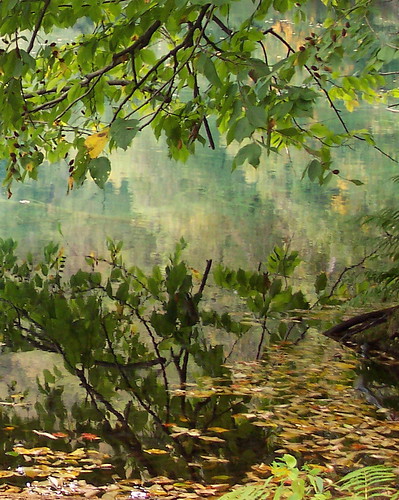
Here's my attempt to take a photograph that looks like a painting.
No matter how miserable my mood, I always feel better as soon as my sneakers touch the mulch trails of Pretty Colour Lake. The autumn smell of yellow leaves mixed with the scent of the cedar trees as Quilt Artist and I started around the lake. Some of the white cedar trees that edge the lake are more than a century old. They were here when my Dad came to the lake as a child. High in the hills just above the lake are remnants of old growth forest.
I've walked the trails at this lake hundreds, no, thousands of times. My earliest memories include family picnics with my parents and Picnic Family, the six of us children collecting bright red leaves and scrambling up the steep hills around the lake. I came to the lake as a teenager to swim, or to camp with Outdoor Girl and her family, or to take quiet walks with a boyfriend. When my own children were small, I usually nursed a baby in a sling as we walked. I come to the lake often in the evening with my husband, when we can sneak an hour or two to ourselves. I bring my out-of-town friends to this lake: I walked this trail with Artist Friend a few years ago, as a way to weave the landscape of cedar trees and green water into our friendship.
Pretty Colour Lakes are meromictic: unlike most lakes in the world, they don't turn over in the spring or fall. The water at the bottom never rises to the surface. I've heard all kinds of local legends about the lakes, including the idea that they are connected to other lakes by underground caves. These small lakes are so deep that they were once believed to be bottomless, although scientists now say that the depth is closer to 195 feet instead of infinity.
But the thing that everyone notices -- and no matter how many times each week I come to the lake, the beauty of it still shocks me -- is the colour of the lakes. Because the lakes are so deep and clear, with little suspended organic matter, and because calcium carbonate seeps from the limestone bedrock, the water is often a spectacular green blue colour that is hard to describe and almost impossible to photograph.
Later in October, the still lake will reflect gorgeous red and orange fall foliage. But yesterday, we saw just the beginnings of the fall changes: gold leaves drifting along the edge of the lake, a few yellow leaves on branches of green. Quilt Artist and I kept stopping to admire the way the branches that overhang the lake were reflected in the water. When a light wind rippled across the surface, the blur of vivid colours looked like a Monet painting.
We had just enough time to walk around both lakes. We talked about friendships and children and a fall weekend we have planned with some of our friends. And then we went back to our homes, refreshed by the conversation, the fresh air, and the colours of the lake.
Here's my attempt to take a photograph that looks like a painting.
September 19, 2006
Reason for hope
During the first four weeks of the semester, I ask my first year students to do all kinds of things outside of class time – an overnight retreat, lectures and workshops, and a play downtown. When I found out that Snowstorm University, the big college next to us, was bringing in Famous Woman Who Discovered that Chimpanzees Use Tools, I told them I would see if I could get us tickets, but that I had already taken up so many of their evenings that I was not making the lecture mandatory. They could come if they wanted. It was completely up to them.
Out of 60 students, all but two signed up for the lecture. The only two who did not come were two who had to work that night.
When I met my students outside their residence hall yesterday evening so that we could walk over to the lecture together, leaving 45 minutes ahead of time so that we could get good seats, some of the students were so excited about seeing Famous Chimpanzee Activist that they could not stand still. "I can't believe we are going to see her in person," one woman said, bouncing up and down as she talked. "She has been my hero all my life."
As we walked from Small Green Campus over to the much bigger campus of Snowstorm University, my students were chattering excitedly and moving so fast I had to practically run to keep up. One student demonstrated some Irish step dancing moves on the concrete steps we had to ascend, and many other students followed suit, dancing sideways up to the top. Some students had gone over even earlier, to wait in line before the doors opened and get the best seats, and they were in constant cell phone contact with the group of us who were walking over now.
We were so early that the big auditorium was still almost empty when we arrived. The first rows were reserved for people more important than us, but we filled in the whole area right behind the reserved section. All around me I could hear students exchanging what information they knew about Chimpanzee Expert: what books they'd read, what television programs they'd seen, and what impact she had had on their lives, bringing many of them to the field of wildlife biology. As we talked, the auditorium around us gradually filled with hundreds of Snowstorm University students.
When Woman Who Lived Near Chimpanzees approached the podium, she could not speak for several minutes because the applause from the first year students went on for so long. When she did speak, she was intelligent, articulate, and inspiring. Her facts were sometimes depressing, but she ended on a note of hope.
I too was thrilled to see Chimpanzee Expert, but the most exciting part of the evening for me was watching the attitudes of my students, who all jumped at the chance to attend the lecture, who sat forward in their seats listening to every word she said, and who afterwards filled the night air with talk of ecology and habitat destruction and grassroots activism. As we walked back to our own campus, following paths splashed with light from the windows of buildings, I could feel their energy rushing all around me, as they talked and danced and bounced their way back to their residence hall. Reason for hope.
Out of 60 students, all but two signed up for the lecture. The only two who did not come were two who had to work that night.
When I met my students outside their residence hall yesterday evening so that we could walk over to the lecture together, leaving 45 minutes ahead of time so that we could get good seats, some of the students were so excited about seeing Famous Chimpanzee Activist that they could not stand still. "I can't believe we are going to see her in person," one woman said, bouncing up and down as she talked. "She has been my hero all my life."
As we walked from Small Green Campus over to the much bigger campus of Snowstorm University, my students were chattering excitedly and moving so fast I had to practically run to keep up. One student demonstrated some Irish step dancing moves on the concrete steps we had to ascend, and many other students followed suit, dancing sideways up to the top. Some students had gone over even earlier, to wait in line before the doors opened and get the best seats, and they were in constant cell phone contact with the group of us who were walking over now.
We were so early that the big auditorium was still almost empty when we arrived. The first rows were reserved for people more important than us, but we filled in the whole area right behind the reserved section. All around me I could hear students exchanging what information they knew about Chimpanzee Expert: what books they'd read, what television programs they'd seen, and what impact she had had on their lives, bringing many of them to the field of wildlife biology. As we talked, the auditorium around us gradually filled with hundreds of Snowstorm University students.
When Woman Who Lived Near Chimpanzees approached the podium, she could not speak for several minutes because the applause from the first year students went on for so long. When she did speak, she was intelligent, articulate, and inspiring. Her facts were sometimes depressing, but she ended on a note of hope.
I too was thrilled to see Chimpanzee Expert, but the most exciting part of the evening for me was watching the attitudes of my students, who all jumped at the chance to attend the lecture, who sat forward in their seats listening to every word she said, and who afterwards filled the night air with talk of ecology and habitat destruction and grassroots activism. As we walked back to our own campus, following paths splashed with light from the windows of buildings, I could feel their energy rushing all around me, as they talked and danced and bounced their way back to their residence hall. Reason for hope.
September 17, 2006
I think I could rise from the ashes
With-a-Why and his father recently started reading comic books together. I've got mixed feelings about comic books, but I admit that I don't know much about them because I've never read them. So when With-a-Why starting talking about them on the way to his piano lesson the other day, I saw it as an opportunity to learn more about my son's new interest.
"Mom, if you could choose any superpower, what would you choose?"
"Any power?"
"Yeah."
"Like a supernatural power?"
"Yeah."
I thought for a minute, and then remembered the motto of a local peace group about turning swords into ploughshares.
"I'd choose the power to turn weapons into loaves of bread."
"What?"
"See, a war could be going on, and I'd snap my fingers, and people would just be throwing loaves of bread at each other. And then they could sit down and make sandwiches and talk to each other."
"That's not a superpower."
"It isn't?"
"No. You have to pick one that someone already has."
"Like shooting flames out of my butt or something like that?"
"Mom! You know what I mean."
"Like it has to be from a comic book? But I don't read comic books."
He decided to give me examples.
"You could be Wolverine. He heals."
"A healer? Like a shaman? That would be cool. I could heal people."
"No, he doesn't heal other people. He heals himself."
"Just himself?"
"Yeah, but he has claws. Made of adamantium. And he can hear and smell really well."
"But he can only heal himself?"
"Yeah. He heals himself. Mostly after he beats the shit out of people."
"Well, that does not sound like a healer."
He took the hint and moved onto another character.
"How about Magneto?"
"What does he do?"
"He can control metal. He's really good at it."
"Metal?"
"Yeah, he wears a helmet that stops Professor X from seeing into his mind."
"What? The professor is a BAD GUY?"
"No, no. Professor X is a good guy. Magneto is a bad guy."
I felt relieved. And decided to take a different tack.
"Aren't there any women with superpowers?"
"Uh, Jubilee. She shoots fireworks."
"Shoots fireworks?"
"Yeah, that's it. She's kind of lame."
"Aren't there any strong women?"
"Oh, yeah, Phoenix. She's strong."
"Wait, I've heard of her. You all went to a movie, and Daughter said Phoenix reminded her of me."
"Yeah."
"What does she do?"
"She gets angry and goes crazy and turns into a giant firebird."
"WHAT? That's like me?"
"It's not me who said it. Big Sister did."
"You think I'm like Phoenix?"
"You don't have as many powers."
I decided it was time to change the subject.
"Okay, which powers would you choose?"
"I'd be Night Crawler. He's blue and has a tail. He can teleport and he's mad acrobatic."
"You want to be blue?"
"I want to teleport and be mad acrobatic."
"Why?"
"I could snowboard down a mountain and whoosh! teleport to the top. I could hang out on top of buildings.
"That doesn't seem all that useful."
"Well, if bad guys chased me around a corner, I could teleport, and they'd think I went into a store or something."
"How often do bad guys chase you?"
"Well, if I'm messing up some evil guy's plan, he's gonna chase me."
"Do you know any evil men?"
He thought for a moment. "George Bush?"
"Mom, if you could choose any superpower, what would you choose?"
"Any power?"
"Yeah."
"Like a supernatural power?"
"Yeah."
I thought for a minute, and then remembered the motto of a local peace group about turning swords into ploughshares.
"I'd choose the power to turn weapons into loaves of bread."
"What?"
"See, a war could be going on, and I'd snap my fingers, and people would just be throwing loaves of bread at each other. And then they could sit down and make sandwiches and talk to each other."
"That's not a superpower."
"It isn't?"
"No. You have to pick one that someone already has."
"Like shooting flames out of my butt or something like that?"
"Mom! You know what I mean."
"Like it has to be from a comic book? But I don't read comic books."
He decided to give me examples.
"You could be Wolverine. He heals."
"A healer? Like a shaman? That would be cool. I could heal people."
"No, he doesn't heal other people. He heals himself."
"Just himself?"
"Yeah, but he has claws. Made of adamantium. And he can hear and smell really well."
"But he can only heal himself?"
"Yeah. He heals himself. Mostly after he beats the shit out of people."
"Well, that does not sound like a healer."
He took the hint and moved onto another character.
"How about Magneto?"
"What does he do?"
"He can control metal. He's really good at it."
"Metal?"
"Yeah, he wears a helmet that stops Professor X from seeing into his mind."
"What? The professor is a BAD GUY?"
"No, no. Professor X is a good guy. Magneto is a bad guy."
I felt relieved. And decided to take a different tack.
"Aren't there any women with superpowers?"
"Uh, Jubilee. She shoots fireworks."
"Shoots fireworks?"
"Yeah, that's it. She's kind of lame."
"Aren't there any strong women?"
"Oh, yeah, Phoenix. She's strong."
"Wait, I've heard of her. You all went to a movie, and Daughter said Phoenix reminded her of me."
"Yeah."
"What does she do?"
"She gets angry and goes crazy and turns into a giant firebird."
"WHAT? That's like me?"
"It's not me who said it. Big Sister did."
"You think I'm like Phoenix?"
"You don't have as many powers."
I decided it was time to change the subject.
"Okay, which powers would you choose?"
"I'd be Night Crawler. He's blue and has a tail. He can teleport and he's mad acrobatic."
"You want to be blue?"
"I want to teleport and be mad acrobatic."
"Why?"
"I could snowboard down a mountain and whoosh! teleport to the top. I could hang out on top of buildings.
"That doesn't seem all that useful."
"Well, if bad guys chased me around a corner, I could teleport, and they'd think I went into a store or something."
"How often do bad guys chase you?"
"Well, if I'm messing up some evil guy's plan, he's gonna chase me."
"Do you know any evil men?"
He thought for a moment. "George Bush?"
Let me be your doormat
Warning: Slight spoiler ahead if you haven't seen the movie The Last Kiss.
Often after a night at the movies, I end up analyzing how unhealthy Hollywood's version of a romantic relationship is. I especially hate the idea that a woman needs a man to "be complete," as if no woman could ever be a whole person on her own.
The movie we saw last night, The Last Kiss, avoided many of the romantic conventions that I so detest. It was certainly more realistic than the cheesy movie with a happy ending that usually falls into the romantic comedy genre. The characters seemed like real people, with real life problems – and completely dysfunctional ways of handling them. And they certainly did avoid the happy ending.
In the end, the main character, who has spent most of the movie sabotaging the relationship he is in, ends up lying for days on the doorstep of the woman he says he loves. She walks over him as she leaves for work, refusing even to talk to him. At one point, she takes pity on him and throws him a sandwich before storming past. When he shivers in the cold, she tosses him a blanket, which he clutches gratefully. The character is played by Zach Braff, and even though he's been a moody, immature jerk for most of the movie, he is still somehow likeable enough that he gets our sympathy. He lies pitifully on the front porch, a broken man, while the woman steps over him again and again.
I am not sure what to make of a romantic comedy in which the main character is counseled by an older male therapist to "do whatever it takes" to get his woman back and who becomes literally a doormat.
If that is a metaphor for relationships in our times, I would say that these are pretty dark times. A realistic movie, perhaps, but certainly a depressing one.
Often after a night at the movies, I end up analyzing how unhealthy Hollywood's version of a romantic relationship is. I especially hate the idea that a woman needs a man to "be complete," as if no woman could ever be a whole person on her own.
The movie we saw last night, The Last Kiss, avoided many of the romantic conventions that I so detest. It was certainly more realistic than the cheesy movie with a happy ending that usually falls into the romantic comedy genre. The characters seemed like real people, with real life problems – and completely dysfunctional ways of handling them. And they certainly did avoid the happy ending.
In the end, the main character, who has spent most of the movie sabotaging the relationship he is in, ends up lying for days on the doorstep of the woman he says he loves. She walks over him as she leaves for work, refusing even to talk to him. At one point, she takes pity on him and throws him a sandwich before storming past. When he shivers in the cold, she tosses him a blanket, which he clutches gratefully. The character is played by Zach Braff, and even though he's been a moody, immature jerk for most of the movie, he is still somehow likeable enough that he gets our sympathy. He lies pitifully on the front porch, a broken man, while the woman steps over him again and again.
I am not sure what to make of a romantic comedy in which the main character is counseled by an older male therapist to "do whatever it takes" to get his woman back and who becomes literally a doormat.
If that is a metaphor for relationships in our times, I would say that these are pretty dark times. A realistic movie, perhaps, but certainly a depressing one.
Subscribe to:
Posts (Atom)